

Table of Contents
- Why Topdress Your Lawn and When to Do It
- What You Need: Materials and Lawn Renovation Equipment
- Step 1: Prepare Your Lawn Before You Spread
- Step 2: Core Aerator Hire vs Manual Spiking
- Step 3: How to Level a Lawn With a Top Dresser
- Manual Spreading vs Hiring a Top Dresser
- Aftercare: Fertilising and Watering for Best Results
- Common Mistakes to Avoid When Topdressing
- Frequently Asked Questions
Last Updated: September 7, 2026
Why Topdress Your Lawn and When to Do It
Topdressing is the practice of spreading a thin layer of sand, soil, or compost over an established lawn, and it remains the best way to topdress residential lawn surfaces that have become uneven, compacted, or thin. This guide walks through the entire process, from choosing materials to operating the right equipment, so you can achieve a level, healthy lawn without calling in a contractor.
A single application of topdressing material helps smooth out low spots, improve soil structure, and encourage stronger root growth. For Mackay lawns, the ideal window is during the active growing season, typically from early spring through autumn, when the grass can recover quickly and grow through the new layer. Avoid topdressing in the middle of a dry winter or just before a forecast heatwave, as the grass needs moisture and active growth to bounce back.
Below, we'll show you exactly how to prepare, aerate, spread, and care for your lawn after topdressing. The 5-step process covered uses professional-grade equipment available for dry hire, so you get a consistent finish without the back-breaking work of spreading sand by shovel and rake.
What You Need: Materials and Lawn Renovation Equipment
Before you spread anything, you need the right material and the right machinery. The most common topdressing material in Mackay is a washed river sand or a screened sandy loam, often mixed with a small amount of compost for organic matter. Avoid clay-heavy soils that will cake and suffocate the lawn, and never use builder's sand, which contains salts and fines that can harm turf.
The equipment you choose determines how fast the job goes and how even the result looks. For a typical residential block, turf management guidance from the Australian Institute of Horticulture suggests that manual spreading suits only the smallest patches, while mechanical spreaders give a far more consistent layer across larger areas.
Method |
Best For |
Coverage Speed |
Consistency |
|---|---|---|---|
Shovel & rake |
Tiny patches under 20 m² |
Slow |
Variable |
Levelling rake & roller |
Small lawns, detailed levelling |
Moderate |
Good |
ECO250-S top dresser |
Residential to acreage lawns |
Fast |
Excellent |
MarKay Outdoors offers [the ECO250-S Sand Spreader & Top Dresser Hire Mackay](https://markayoutdoors.com.au/products/eco250-s-sand-spreader-hire-mackay) for $300 same-day hire, which uses a conveyor and twin-spinner system to distribute material evenly. For smaller jobs, the Lawn Leveling Rake & Roller Hire bundle at $30 is a budget-friendly option for achieving a smooth finish.


Step 1: Prepare Your Lawn Before You Spread
Start by mowing the lawn shorter than usual, down to about 2 to 3 cm, and collect the clippings. This gives the topdressing material direct contact with the soil surface rather than sitting on top of long grass blades.
Next, clear the entire area of sticks, rocks, toys, and any debris that could interfere with spreading. If you have irrigation heads or shallow sprinkler lines, mark their locations so you don't damage them with machinery or the levelling rake.
A common mistake is skipping the dethatching step. If your lawn has a thick, spongy layer of dead grass and organic matter, the topdressing will sit on top of the thatch instead of reaching the soil. Hiring a Dethatcher Hire Mackay | Lawn Scarifier & Thatch Removal for $150 same-day removes this buildup, opening up the surface so air, water, and nutrients can penetrate.
Step 2: Core Aerator Hire vs Manual Spiking
Aeration is the step most DIYers skip, and it's the one that makes the biggest difference to how well topdressing works. The question is whether to hire a core aerator or simply spike the lawn with a garden fork.

Lawn Aerator & Trailer Hire Mackay | Core Aerator Hire
Manual spiking with a fork pushes solid tines into the ground, creating small holes but also compacting the soil around each hole. It's cheap and fine for a very small patch, but it does little to relieve compaction across an entire lawn. Core aeration physically removes plugs of soil, creating real space in the root zone and giving the topdressing material somewhere to work into.
For most residential lawns, core aerator hire is the better investment. MarKay Outdoors provides the Lawn Aerator & Trailer Hire Mackay | Core Aerator Hire for $190 same-day, with the transport trailer included. The machine removes small cores of soil, relieving compaction and creating channels for air, water, and nutrients. Run the aerator over the lawn in two directions for the best coverage, and leave the cores on the surface to break down naturally.
Step 3: How to Level a Lawn With a Top Dresser
With the lawn prepared and aerated, it's time to spread the topdressing material. The best way to topdress residential lawn areas evenly is with a purpose-built top dresser, which controls the flow of material far better than a shovel ever could.
The ECO250-S Sand Spreader & Top Dresser Hire Mackay is a self-propelled machine with a 326 L hopper and an adjustable spreading width from approximately 1.22 m to 5.49 m. It applies up to 6.35 mm of material per pass, which is the ideal thickness for most lawns. Applying more than this in a single pass risks smothering the grass.
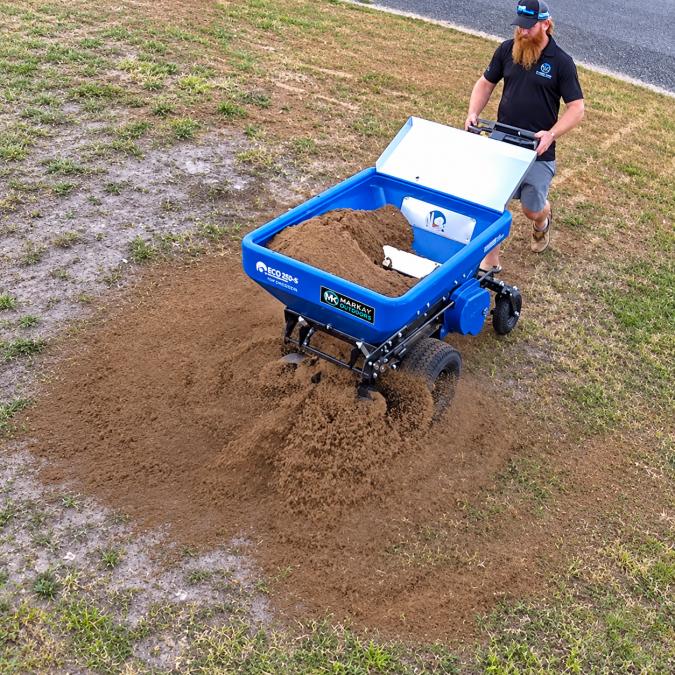
A person operating a self-propelled ECO250-S top dresser machine, spreading a thin layer of sand evenly across a residential lawn in Australia. The photo shows the hopper and the even spread pattern on the grass.
Load the hopper with screened sand or your chosen topdressing mix, set the gate height, and walk the machine in straight, overlapping passes, similar to mowing. For low spots, make a second pass over just those areas rather than dumping a thick layer everywhere. The machine's 864 mm width allows access to most residential properties.
Manual Spreading vs Hiring a Top Dresser
If you're topdressing a very small lawn, say under 50 m², manual spreading with a levelling rake and roller can work well. You shovel out small piles of sand, rake them flat, and roll the surface to settle it. It's slow, but it gives you hands-on control over every patch.
For anything larger, the time savings from a mechanical top dresser are substantial. Spreading sand by hand across a 300 m² lawn can take a full day of hard labour, while the ECO250-S covers the same area in a fraction of the time with a far more consistent result. The machine also uses a gearbox-driven twin-spinner system that throws material evenly, avoiding the lumpy, uneven finish that often comes from raking by hand.
The cost difference is worth considering. The leveling rake and roller bundle hires for $30, while the ECO250-S top dresser hires for $300 same-day. If your time is valuable and your lawn is larger than a small courtyard, the top dresser pays for itself in saved effort and a better finish.
Aftercare: Fertilising and Watering for Best Results
Topdressing is not the end of the job. The material needs to be worked into the lawn and the grass needs a nutrient boost to recover and grow through the new layer.
After spreading, lightly drag the back of a rake over the surface to work the sand down into the grass canopy and into the aeration holes. Then roll the lawn with a water-filled roller to settle the material and smooth out any remaining bumps. MarKay Outdoors offers the Lawn Leveling Rake & Roller Hire bundle for this exact purpose.
Watering is critical in the first few weeks. The topdressing layer must stay consistently moist so the grass can root through it, but avoid waterlogging. In Mackay's climate, this usually means watering lightly every day for the first two weeks, then tapering off as the lawn establishes.
Fertilising helps the lawn push new growth through the sand layer. MarKay Outdoors stocks LawnHub lawn care products locally, including [the LawnHub Trojan 5kg Slow Release Fertiliser](https://markayoutdoors.com.au/products/trojan-5kg) at $33.88, which provides controlled-release nutrition for up to 12 weeks. A starter fertiliser like LawnHub GOT LAID 5kg at $32.88 is better suited if you're also laying new turf patches.
Common Mistakes to Avoid When Topdressing
The most common mistake is applying the layer too thickly. Anything over about 12 mm in a single application can smother the grass and cause it to die off in patches. It's far better to apply two thin layers a few weeks apart than one thick layer.
Another frequent error is topdressing without aerating first. The sand then sits on the surface and washes away in the first heavy rain, doing nothing to improve the soil structure below. Always dethatch and aerate before you spread.
Skipping the preparation of your material also causes problems. Wet, clumpy sand will not feed through a spreader evenly, and oversized material can jam the conveyor. Ensure your topdressing mix is dry enough to flow freely and is screened to a consistent size.
Finally, don't neglect the aftercare. A lawn that isn't watered consistently after topdressing will struggle to push roots through the new layer, leaving you with a sandy surface and a patchy lawn months later.
Topdressing is one of the most effective ways to renovate a tired, uneven lawn, but the results depend entirely on preparation and the right equipment. By dethatching, aerating, and spreading a thin, even layer with a mechanical top dresser, you give your lawn the best chance to thrive. For Mackay homeowners tackling this project, MarKay Outdoors offers the full range of lawn renovation equipment for dry hire, from the core aerator and dethatcher to the ECO250-S top dresser and levelling rake. Get started with MarKay Outdoors and book your equipment online to transform your lawn this season.
Frequently Asked Questions
Do I need to aerate before topdressing my lawn?
Yes, core aeration before topdressing is highly recommended. Aeration relieves soil compaction and creates channels for air, water and nutrients. When you then topdress, the fine sand or soil mix can work its way into these aeration holes, which helps improve the soil profile from the surface down. For established lawns in Mackay with heavy traffic, hiring a core aerator beforehand makes the topdressing far more effective than simply spreading material on a compacted surface.
How thick should a layer of topdressing be?
For a residential lawn, you should aim for a layer no thicker than 6 to 13 millimetres per application. Applying more than this in a single pass can smother the grass. The EcoLawn ECO250-S top dresser is designed to apply up to 6.35 mm per pass, which is ideal. If your lawn needs more levelling, it is better to apply multiple thin layers over several weeks or months, allowing the grass to recover between applications.
What is the best material to use for topdressing a lawn?
The best material depends on your soil type, but a common and safe choice is a sandy loam or a screened top-dressing mix. For Mackay lawns, washed river sand is often used to level minor undulations without changing the soil composition too dramatically. If you need to improve nutrient content, you can mix in screened compost. Ensure the material is free of weeds, rocks and large lumps, as wet or oversized material will not spread evenly through a top dresser.
Can I topdress my lawn if it is uneven, or do I need to fix the level first?
Yes, you can use topdressing to fix minor unevenness. This is the process of how to level a lawn using a top dresser. For dips and hollows deeper than about 25 mm, it is better to fill them with a slightly thicker layer of material first, then use a top dresser across the whole lawn for a consistent finish. For large, severely uneven areas, you may need to consider more substantial earthworks, but for most residential lawns a few passes with a top dresser will sort out the small bumps and hollows.