

Table of Contents
- Why Heavy Clay Soil Makes Aeration Essential
- Core Aeration vs Spiking: What Works on Clay
- What You'll Need Before You Start
- Step-by-Step: How to Aerate Lawn with Heavy Clay Soil
- Core Aerator Hire: What to Look For
- Top Dressing Clay Soil After Aeration
- Lawn Renovation Equipment Hire for Clay Lawns
- Common Mistakes to Avoid
- Frequently Asked Questions
Last Updated: September 16, 2026
Why Heavy Clay Soil Makes Aeration Essential
Heavy clay soil compacts into a dense, airless layer that roots struggle to push through. When you aerate lawn with heavy clay soil, you're not just punching holes in the surface; you're reopening the pore spaces that let water, oxygen and nutrients actually reach the root zone. In clay-dominant gardens, those pore spaces collapse faster than in sandy or loamy soils, which is why compaction returns so quickly after rain or regular foot traffic.
This guide walks through the practical method: how to read the signs of compaction, why core aeration beats spiking on clay, and the exact steps to run an aerator without making the problem worse.
Signs Your Clay Lawn Is Compacted
Compaction rarely announces itself. It shows up slowly, through symptoms most homeowners misread as drought stress or disease.
Watch for these signals:
- Water pools on the surface after rain or irrigation instead of soaking in
- The lawn develops dry, crispy patches even when you're watering regularly
- Grass feels spongy or springy underfoot in some areas, rock-hard in others
- Weeds like plantain and bindii move in where grass thins out
- A screwdriver or garden fork won't push easily into the soil
If two or more of these sound familiar, the soil structure has likely broken down and core aeration is the right next step.
Core Aeration vs Spiking: What Works on Clay
Core aeration removes small plugs of soil from the lawn, creating real voids that relieve compaction. Spiking, by contrast, pushes solid tines into the ground, which can actually worsen compaction on clay by squeezing soil sideways.
That distinction matters more on clay than on any other soil type.
Why Solid Tines Fall Short
Solid tine spiking works acceptably on sandy or loamy soils where structure recovers quickly. On heavy clay, the tines compress the soil around each hole rather than loosening it. You end up with a lawn full of tight, glazed holes that shed water instead of absorbing it.
Core aeration solves this by physically removing material. The resulting holes hold their shape, giving air and water a genuine pathway into the profile. This is also why core aeration pairs so well with top dressing: the openings give the sand or topdressing material somewhere to settle.
What You'll Need Before You Start
Gather the following before you begin:

- A walk-behind core aerator (hire is the practical option for most homeowners)
- A trailer to transport the machine, unless the hire includes one
- Marker flags or a hose to mark irrigation lines and shallow cables
- A rake and garden bags for collecting cores
- Top dressing material (washed sand or a suitable sandy loam) if you plan to level afterwards
- A soil wetting agent if the lawn has developed hydrophobic patches
MarKay Outdoors stocks LawnHub soil wetting agents locally for lawns that repel water, and hires core aerators with the trailer included so you can tow the machine home and get straight into the job.

Step-by-Step: How to Aerate Lawn with Heavy Clay Soil
The process is straightforward, but the order matters. Skipping preparation or rushing the clean-up undoes most of the benefit.
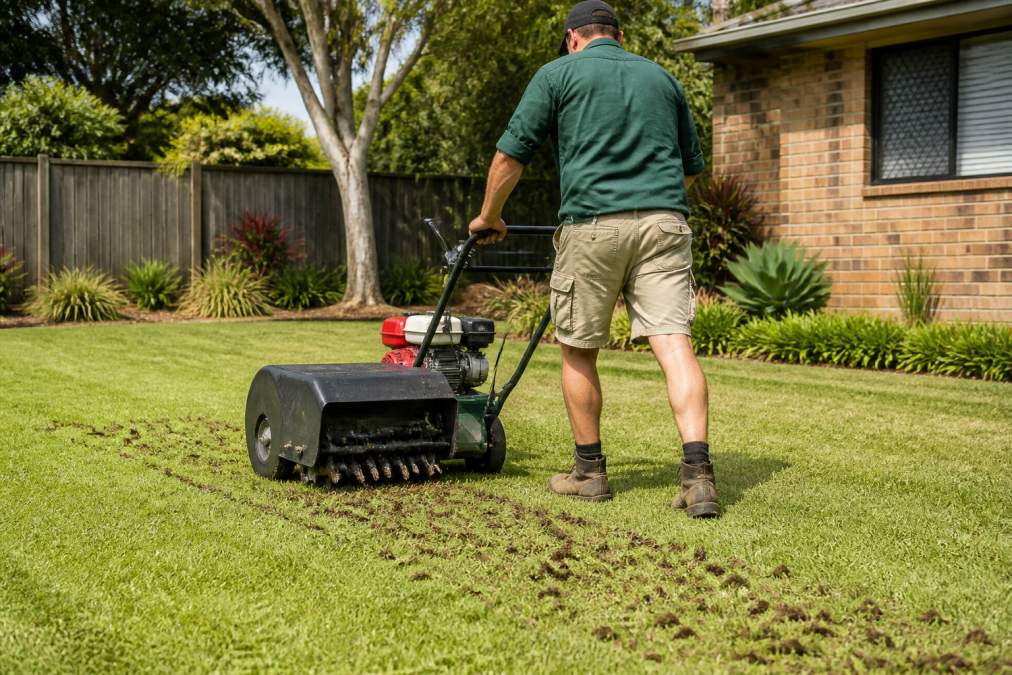
Step 1: Prepare the Lawn
Water the lawn two to three days before aerating so the clay is soft but not waterlogged. Mark any irrigation lines, shallow cables or sprinkler heads with flags. If thatch has built up heavily, dethatch first so the aerator tines reach soil rather than matted organic matter.

Step 2: Run the Core Aerator
Set off in straight, overlapping passes across the lawn, the same way you'd mow. On badly compacted clay, go over the area twice in crossing directions. Keep a steady walking pace; slowing down doesn't produce deeper holes, it just clogs the tines.
Step 3: Break Up and Distribute the Cores
Let the plugs dry for a day or two, then break them up with a rake or run a mower over them with the catcher off. The broken soil works back into the lawn surface and helps dilute the clay layer over time.
Lawn Aerator & Trailer Hire Mackay →
Core Aerator Hire: What to Look For
Core aerator hire gives you the machine without the storage problem, and for a job you'll run once or twice a year, that's the sensible route. Look for a hire package that includes the trailer, since transporting a walk-behind aerator without one is awkward and unnecessary.
Check the machine's tine condition before you leave the yard. Worn or bent tines punch ragged holes and struggle in clay. Confirm the working width so you can estimate how many passes you'll need, and ask about the fuel setup so you're not caught short mid-job.
MarKay Outdoors runs a lawn aerator and trailer hire package that includes the trailer in the hire price, which removes the transport headache entirely.
| Hire Option | What's Included | Best For |
|---|---|---|
| Aerator + trailer | Core aerator, trailer | Single-task aeration jobs |
| Lawn care trailer package | Dethatcher, core aerator, rakes, garden bags, trailer | Full renovations with thatch removal |
Top Dressing Clay Soil After Aeration
Top dressing clay soil after aeration is where the real improvement happens. The aeration holes give the topdressing material somewhere to sit, and over successive seasons the sand or sandy loam works down and gradually opens up the clay profile. Spread a thin layer, no more than 10-15mm, and work it into the holes with a rake or drag mat. Doing this in the same session as aeration is far more effective than top dressing a compacted, unaerated lawn, where the material just sits on the surface.
Lawn Renovation Equipment Hire for Clay Lawns
Lawn renovation equipment hire makes sense when you're tackling more than aeration. A full renovation on clay typically means dethatching first to strip excess thatch, aerating to open the soil, then top dressing to level and improve structure. Hiring the equipment as a package keeps the sequence tight and avoids the cost of buying machines you'll use twice a year.
MarKay Outdoors runs a lawn care trailer hire package that bundles a dethatcher, core aerator, rakes and garden bags on one trailer, so the whole renovation can happen in a single weekend.
Common Mistakes to Avoid
The most common mistake is aerating dry clay. The tines bounce off the surface and the holes collapse almost immediately. Water the lawn a couple of days beforehand.
The second is skipping the clean-up. Leaving the cores on the surface smothers the grass underneath and looks untidy for weeks. Break them up once they've dried.
The third is aerating too shallow. Set the tines to pull a proper plug, not a surface scratch. Shallow aeration on clay achieves very little.
Finally, don't top dress immediately after a heavy rain on saturated soil. Wait for the surface to firm up, or the topdressing and the soil beneath it turn into a slurry.
Clay soil doesn't have to stay compacted forever. The right sequence, dethatch if needed, core aerate when the soil is moist, break up the cores, then top dress, makes a measurable difference over a season or two. MarKay Outdoors offers core aerators with the trailer included, stocks LawnHub soil wetting agents locally, and provides a full lawn care trailer package with dethatcher, aerator, rakes and garden bags so you can complete the whole renovation in one go. Get started with MarKay Outdoors and give your clay lawn the soil structure it's been missing.
Frequently Asked Questions
Is core aeration effective for heavy clay soil?
Core aeration is the most effective method for heavy clay soil because it removes small plugs of soil rather than just punching holes. This creates open channels that let air, water and nutrients reach the root zone. On clay, those channels last longer than solid tine holes, which tend to seal shut. For best results, aerate when the soil is moist but not waterlogged, then follow with top dressing to improve soil structure over time.
How often should you aerate a lawn with clay soil?
Most clay lawns benefit from core aeration once or twice a year. If your lawn gets heavy foot traffic or the soil compacts quickly, aim for twice yearly, typically in early autumn and again in spring. For severely compacted clay, you may need to aerate more frequently for the first couple of years. After that, annual aeration usually maintains the results, especially if you top dress and manage watering well.
Should I top dress after aerating clay soil?
Yes, top dressing after aeration is one of the best things you can do for clay soil. The holes left by core aeration give top dressing material somewhere to sit, so it works down into the root zone rather than just sitting on the surface. Use a suitable sand or top dressing mix and spread it evenly. This gradually improves soil structure and drainage over several seasons. A top dresser makes the job much faster and more consistent.
Can I use a manual aerator on heavy clay?
Manual aerators can work on heavy clay, but they are hard going. Clay is dense and resists penetration, so you will need to aerate when the soil is soft after rain or watering. For small areas, a manual plug aerator is manageable. For anything larger than a courtyard, a powered core aerator is far more practical. Hire options make powered aeration accessible for a weekend project without the cost of buying.