

Table of Contents
- What Makes a Kanga Loader Suitable for Residential Work
- Kanga Loader Narrow Access Capabilities: What Actually Fits
- How to Choose the Right Size Mini Loader for Your Job
- Residential Projects Where a Mini Loader Earns Its Hire Fee
- When a Kanga Loader Is Overkill: Simpler Equipment to Consider
- Mini Loader Hire for DIY Projects: What to Expect on the Day
- Conclusion
Last Updated: 24 August 2026
What Makes a Kanga Loader Suitable for Residential Work
The question of whether a kanga loader residential project is a good match comes down to one thing: what the machine actually does versus what your job actually needs. At MarKay Outdoors, we get this question regularly from homeowners who've seen the machines on job sites and aren't sure if hiring one is sensible for a backyard renovation or a modest landscaping job.
A Kanga mini loader is a compact, walk-behind or ride-on machine that uses hydraulic attachments to dig, move material, trench, auger post holes, and level ground. Unlike a full-sized excavator or skid steer, it's designed specifically for jobs where access is tight and the scale of work doesn't justify a large machine. That's exactly why it suits residential work so well.
The honest answer is that a Kanga loader is rarely overkill for residential projects, but it can be the wrong tool if your job is genuinely small-scale, or if the access to your site won't accommodate even a compact machine. The key variables are the scope of your job, the width of your access points, and whether you actually need a powered loader or whether a simpler piece of equipment would do the same job faster and cheaper.
What makes Kanga loaders genuinely useful for residential work is their attachment versatility. One machine can dig, level, trench, and drill post holes in a single hire period. For any job that involves more than one of those tasks, a mini loader will almost always save you more time than it costs.
According to Horticulture Innovation Australia's guidance on residential landscaping equipment, the right equipment choice for residential projects depends heavily on matching machine capability to site constraints rather than defaulting to the largest available option.
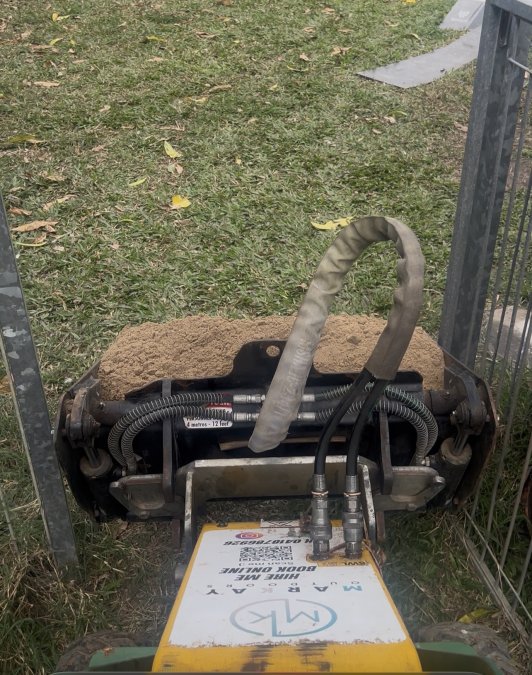
A compact Kanga KID mini loader navigating through a narrow residential side gate, showing just centimetres of clearance on either side in afternoon sunlight
Kanga Loader Narrow Access Capabilities: What Actually Fits
Access is the deciding factor for most residential jobs. You might have the perfect project for a mini loader, but if the machine can't get through your side gate or down a narrow pathway, none of that matters.
Kanga loaders are purpose-built for narrow-access work. The two machines in the MarKay Outdoors hire fleet have meaningfully different widths, and that difference changes which jobs each one suits.
Kanga KID KK216: The 800mm Option for Tight Backyards
The Kanga KID KK216 is approximately 800mm wide. That's the measurement that matters most when you're trying to work out whether a mini loader will fit through your side access.
Most residential side gates in Queensland are between 900mm and 1,000mm wide, which means the KK216 will fit through the majority of standard residential access points with a reasonable margin. If you're unsure whether your access is wide enough, measure the narrowest point, including any fence posts or gate hardware, before you book.
The KK216 comes with a 4-in-1 bucket, 250mm and 300mm auger, levelling bar, cement mixing bowl, and a trencher that cuts approximately 100mm wide and up to 600mm deep. For most residential landscaping jobs, that's a complete attachment set. You won't need to hire additional machines to handle different stages of the work.
This is the machine most homeowners should be looking at first. It handles the majority of residential projects without the access limitations of a larger loader.
Kanga PW628: When You Have the Space and Need More Grunt
The Kanga PW628 Series 6 is the larger machine in the MarKay Outdoors fleet. It's suited to jobs where access isn't a constraint and you need the additional capability that comes with a bigger loader.

The PW628 carries a wider 4-in-1 bucket at 1,070mm, and its trencher cuts approximately 150mm wide and up to 900mm deep, meaningfully more capacity than the KK216 for heavy digging and larger material-moving jobs. Additional attachments including a front hoe, rubble bucket, and debris puller are also available depending on your project.
If you're working on a larger residential block, a rural property, or a site where access isn't restricted, the PW628 gives you more capability per hire day. For standard suburban backyards with typical side-gate access, the KK216 is usually the practical choice.
How to Choose the Right Size Mini Loader for Your Job
Choosing between the two Kanga loaders isn't complicated once you know what to look at. Most people overthink it.
Access Width, Job Scope and Attachment Needs
Work through these three questions before you book:
Access width: Measure the narrowest point of your access route, the gate opening, not just the fence gap. Account for gate posts, hinges, and any overhead clearance issues. If your narrowest point is under 850mm, the KK216 is your only option. If it's 1,200mm or more, either machine will fit.
Job scope: Are you moving a few cubic metres of soil, or are you digging out a large area, trenching a full irrigation run, and levelling a new lawn area? Bigger scope generally favours the PW628. Tight, detailed work in a confined yard favours the KK216.
Attachment needs: Both machines cover the core residential attachment set. If you need the PW628-specific attachments (rubble bucket, debris puller, front hoe), that will guide your decision. For standard digging, post holes, trenching, and levelling, both machines cover you.
Consideration |
Kanga PW628 |
|
|---|---|---|
Width |
~800mm |
Wider (check access) |
Best access |
Narrow gates, tight yards |
Open access, larger sites |
Trencher depth |
Up to 600mm |
Up to 900mm |
Bucket width |
Standard |
1,070mm |
Best for |
Most residential jobs |
Larger blocks, rural sites |
Hire period |
Same-day to 7 days |
Same-day to 7 days |
If you're genuinely unsure which machine suits your job, contact MarKay Outdoors before booking and describe your access width and what you're trying to do. That's a much better approach than guessing and arriving with the wrong machine.

Residential Projects Where a Mini Loader Earns Its Hire Fee
Some jobs are genuinely suited to a mini loader. Others aren't. Knowing the difference saves you money and frustration.
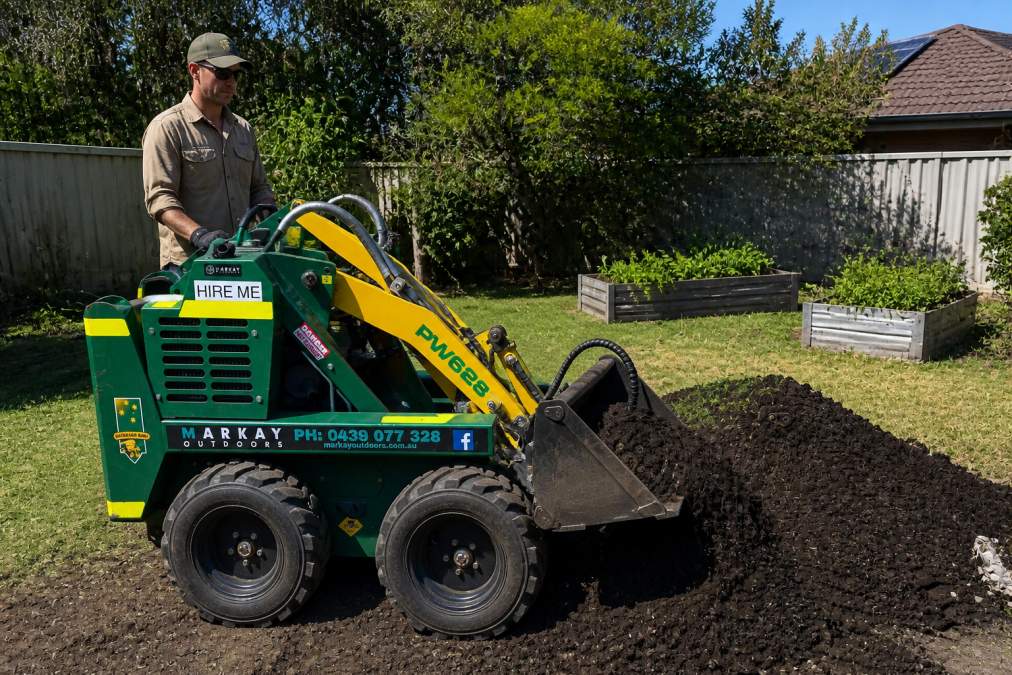
A kanga loader residential hire genuinely earns its cost when the job involves multiple tasks, significant material movement, or ground that's too hard to work by hand in a reasonable timeframe. Here are the project types where hiring a mini loader makes clear practical sense:
Backyard landscaping and renovation: Moving soil, spreading material, levelling areas, and preparing ground for new turf or garden beds. A job that would take two people a full weekend with hand tools can often be done in a few hours with a Kanga.
Post holes and fencing: The auger attachment drills clean, consistent holes faster than a hand-held auger and with far less physical effort, particularly in compacted clay soils common in this region.
Irrigation and trenching: Running irrigation lines, conduit, or water services requires a consistent trench depth. The trencher attachment handles this accurately, and the KK216's 600mm depth suits most residential irrigation work.
Retaining wall preparation: Digging out, levelling, and moving fill material for a retaining wall project involves exactly the kind of multi-stage work a Kanga handles well.
Site clean-up and material handling: Shifting rubble, old pavers, soil, gravel, or landscaping materials across a property is physically demanding work. A mini loader turns a half-day job into an hour's work.
According to Queensland Government's guidance on safe equipment operation for DIY projects, operators of hired machinery should familiarise themselves with the equipment's controls and safe operating procedures before starting work on site.
When a Kanga Loader Is Overkill: Simpler Equipment to Consider
Here's the honest part: not every job needs a mini loader.
A kanga loader residential hire is probably overkill if your job is small enough that a simpler piece of equipment would do it faster, cheaper, or with less setup time. The machine still needs to be collected, transported, and operated, and if your job takes two hours, a half-day hire of a simpler tool might be the more practical choice.
Soil preparation for garden beds: If you're breaking up and cultivating an existing garden bed or preparing a new one, a rotary hoe handles this job more efficiently than a mini loader. A rotary hoe is simpler to operate for homeowners who just need to loosen and cultivate ground.

Compaction work: If your job is primarily about compacting soil, gravel, or paving base material, a plate compactor (wacker packer) is the right tool. It's simpler to operate, easier to transport, and purpose-built for compaction in a way a mini loader isn't.
Small lawn renovation: If you're aerating, dethatching, or top dressing an established lawn, dedicated lawn renovation equipment is more appropriate than a mini loader. Lawn Care Equipment Hire Mackay through MarKay Outdoors includes aerators, dethatchers, and top dressers specifically designed for this work, and these tools are often more efficient for single-task lawn projects than a mini loader.
One-task jobs: If your entire project is a single task, drilling one or two post holes, for example, it's worth considering whether the hire cost and logistics of a mini loader are justified for that specific job. Sometimes a hand-held auger or a simpler hire option makes more sense.
The point isn't that a Kanga is too big. It's that the right tool is the one that matches your actual job, not the most capable one available.
Mini Loader Hire for DIY Projects: What to Expect on the Day
Mini loader hire for DIY projects is more straightforward than most first-timers expect, but there are a few things worth knowing before you collect the machine.
Collection and transport: Both Kanga loaders are supplied on a trailer for collection from Pleystowe. Your tow vehicle needs a minimum 2-tonne towing capacity for the PW628. Check your vehicle's rated towing capacity before booking, this isn't something to guess at. If you're unsure, contact MarKay Outdoors before you commit to a booking.
Fuel bond: All hire machines are supplied with a full tank of fuel and must be returned full. A refundable fuel bond of $80 applies to Kanga loaders. Return the machine with a full tank and the bond is refunded in full.
Operating the machine: Kanga loaders are designed to be operated by people without specialist training, but they do require a sensible approach. Read the operating instructions, start with the basic bucket functions before moving to attachments, and work at a pace that keeps you in control of the machine. The controls are intuitive, but give yourself 15-20 minutes to get comfortable before you start on the main work.
Planning your hire period: A same-day hire gives you pickup and drop-off on the same day. A 24-hour hire gives you more flexibility. For larger residential jobs, a weekend hire (Friday afternoon to Sunday afternoon) often gives the best value and enough time to complete the work properly without rushing.
As noted in Safe Work Australia's guidance on plant and equipment safety, operators of hired plant should review the equipment's operating manual and understand the machine's controls, capacities, and hazards before commencing work.
A common mistake on first hires is underestimating how much prep work needs to happen before the machine arrives. Mark out your work areas, move anything fragile or obstructing, and have a clear plan for where you're putting the material you move. The machine works fast, your site prep should match that pace.
Choosing the right compact equipment for a residential job is genuinely worth thinking through before you book. MarKay Outdoors carries both the Kanga KID KK216 and the Kanga PW628 Series 6 for dry hire, along with a full range of attachments that let you tackle multiple stages of a project with one machine. Whether your job calls for a narrow-access mini loader or a larger machine with more digging capacity, the Equipment Hire Mackay range covers the most common residential project types. View equipment and hire prices at MarKay Outdoors and book the machine that suits your actual job.
Frequently Asked Questions
Can a Kanga loader fit through a standard residential gate?
The Kanga KID KK216 is approximately 800mm wide, which allows it to pass through many standard residential side gates. The larger Kanga PW628 is wider and better suited to properties where access isn't restricted. Before hiring, measure your narrowest access point — gate posts, fences, and steps are the most common obstacles. If you're unsure which machine suits your access, contact MarKay Outdoors before booking.
What types of residential projects benefit most from a mini loader hire?
Mini loader hire for DIY projects delivers the most value when manual labour would take days or cause strain. Common residential uses include moving large volumes of soil, gravel or mulch, digging post holes, trenching for irrigation lines, levelling yard areas and backfilling. The Kanga's interchangeable attachments mean one hired machine can handle multiple stages of the same project, which reduces both time and cost compared to hiring separate equipment.
How difficult is it to operate a Kanga loader if you've never used one before?
Kanga loaders are designed to be operated by non-professionals, which is why they're popular for dry hire. The controls are straightforward, and most first-time operators find them manageable after a short familiarisation period. That said, working on slopes, near structures or in tight spaces requires care. If you have questions about operating a specific machine before your hire, reach out to MarKay Outdoors — they can help you understand what to expect.
What attachments are available for residential Kanga loader hire?
Both the Kanga KID KK216 and PW628 come with multiple attachments. The KID includes a 4-in-1 bucket, 250mm and 300mm augers, a levelling bar, cement mixing bowl and trencher. The PW628 adds a larger 1070mm 4-in-1 bucket, auger options up to 450mm, a deeper trencher and additional attachments including a front hoe and rubble bucket. The right attachment depends on your specific job, so check the hire listing or contact MarKay Outdoors if you're unsure.