

Table of Contents
- Your 2026 Lawn Care Schedule at a Glance
- Summer: Heat, Water and Weed Pressure
- Autumn: Repair, Aerate and Feed
- Winter: The Quiet Season for Soil Work
- Spring: Renovation and Recovery
- How to Use a Dethatcher Without Damaging Your Lawn
- The Best Time for Lawn Top Dressing (and How to Get It Right)
- Building Your Product Program Around the Schedule
- Frequently Asked Questions
Last Updated: September 18, 2026
Your 2026 Lawn Care Schedule at a Glance
A lawn care maintenance schedule 2026 is a season-by-season plan for feeding, watering, aerating and de-thatching your grass so it stays thick and healthy all year. This guide breaks the year into four blocks, explains what each task actually does, and shows which machines you can hire to do the heavy work yourself.

Get the timing wrong and you waste effort. Aerate in the middle of a heatwave and you stress the roots. Top dress too late in spring and you smother new growth. Below, we'll show you exactly what to do in each season, and when to hire equipment instead of doing it by hand.
| Season | Core Tasks | Hire Equipment to Consider |
|---|---|---|
| Summer | Deep watering, wetting agents, weed control, higher mowing | Top dresser for levelling worn patches |
| Autumn | Core aeration, de-thatching, feeding | Core aerator, dethatcher |
| Winter | Soil work, planning, minimal disturbance | Kanga mini loader for soil and material handling |
| Spring | Renovation, top dressing, recovery feeding | Dethatcher, aerator, top dresser |
Summer: Heat, Water and Weed Pressure
The biggest mistake in summer is watering little and often. That trains shallow roots, which then cook in the first hot spell. Water deeply and less frequently so moisture reaches down where it counts.
Watering and wetting agents
A soil wetting agent helps water penetrate instead of pooling or running off, which matters on the sandy and compacted soils common around the region. Apply it early in the season before the lawn is already stressed.
Water in the early morning. Evening watering leaves blades wet overnight, which invites fungal problems during humid stretches.
Weed control and mowing height
Raise your mowing height in summer. Taller blades shade the soil, reduce evaporation and crowd out weeds. Scalping a lawn in January is one of the fastest ways to invite bindii and crabgrass.
For broadleaf weeds, a selective herbicide does the job without harming the turf. The LawnHub Grow & Blow Pack pairs a controlled-release fertiliser with a selective broadleaf herbicide.
Autumn: Repair, Aerate and Feed
Autumn is the single most valuable window in the whole schedule. The heat has eased, the soil is still warm, and the lawn is actively growing, which means it recovers quickly from mechanical work.
What aeration actually does for your soil
Core aeration is the process of removing small plugs of soil from the lawn to relieve compaction and let air, water and nutrients reach the root zone. Those holes give roots room to expand and give water somewhere to go instead of running off.
The lawn aeration benefits show up over the following weeks, not overnight. Expect deeper roots, better drought tolerance and a lawn that responds properly to fertiliser.
Choosing between a core aerator and a dethatcher
These two get confused constantly. They solve different problems.
- Core aerator: removes soil plugs to fix compaction. Use when water pools, the surface feels hard, or the lawn has gone thin over a hard layer.
- Dethatcher: rakes out the layer of dead stems and roots sitting on top of the soil. Use when water struggles to reach the soil and the lawn feels spongy underfoot.
Many lawns need both, and the order matters. De-thatch first, then aerate, then feed. If you only have time for one, aerate. Compaction is the harder problem to fix.
Winter: The Quiet Season for Soil Work
Winter is not a write-off. In this climate the lawn slows down but rarely stops, so the season suits preparation rather than aggressive treatment.
Hold off on heavy fertilising. Growth is slow, and unused nutrients leach away or feed weeds instead of grass. Keep mowing occasionally at a slightly higher height, and water only when the lawn actually dries out.
Winter is the right time to plan the spring renovation. Work out what materials you need, where they will come from, and how you will move them. That is where a Kanga mini loader earns its keep, handling soil, mulch and sand without a wheelbarrow and a bad back. You can view the Kanga PW628 to see what it handles.
Spring: Renovation and Recovery
Spring is for fixing what winter exposed. Bare patches, uneven ground and a tired, thinning lawn all get addressed now, while the grass has a full growing season ahead to recover.
The order is de-thatch, aerate, top dress, then feed. Skip a step and the next one works less well. Top dressing over thatch, for example, just buries the problem.
What to hire for a full renovation
A full renovation needs three machines, and hiring them as a set saves multiple trips:
- Dethatcher to strip out the dead layer
- Core aerator to open up the soil
- Top dresser to spread sand or soil evenly
The lawn care trailer package bundles the dethatcher and aerator with a trailer.
How to Use a Dethatcher Without Damaging Your Lawn
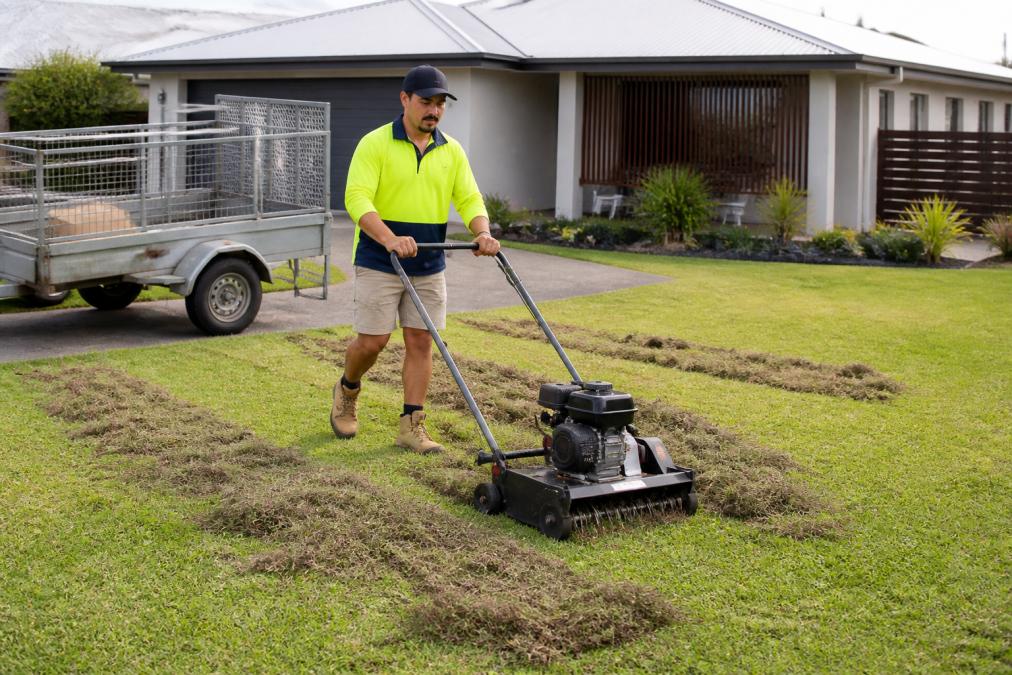
A dethatcher removes thatch, the matted layer of dead organic material between the grass blades and the soil surface. Used correctly, it opens the lawn up.
Follow these steps:
- Mow slightly shorter than usual, then collect the clippings.
- Water lightly a day before so the soil is soft but not muddy.
- Set the tines shallow for the first pass.
- Work in straight, overlapping lines, then repeat at 90 degrees.
- Collect the pulled thatch. Leaving it on the lawn defeats the purpose.
- Water and feed within a few days to help recovery.
The Best Time for Lawn Top Dressing (and How to Get It Right)
The best time for lawn top dressing is early spring or early autumn, when the lawn is growing strongly and can grow through the applied layer. Top dressing is a sand or soil blend spread thinly over the surface to level uneven ground and improve the soil structure around the roots.
Spread it in layers no thicker than about a centimetre at a time, and work it into the surface with a rake or a drag mat. Doing this by hand on anything larger than a small courtyard is slow and uneven, which is exactly what a top dresser solves.
Building Your Product Program Around the Schedule
Equipment and products only work when they line up with the season. A fertiliser applied in the wrong month is money wasted, and a machine hired a fortnight too late undoes the benefit.
Match your program to the calendar:
- Summer: wetting agents and selective weed control
- Autumn: aeration, de-thatching and a balanced feed
- Winter: planning and material handling
- Spring: renovation, top dressing and recovery feeding
Frequently Asked Questions
What are the essential lawn care tasks for each season?
Summer is about watering, weed control and mowing at the right height. Autumn is the key renovation window: aerate, dethatch and feed while the soil is still warm. Winter slows growth, so focus on soil improvement and planning. Spring is for recovery, top dressing and applying a balanced fertiliser program. Following a lawn care schedule built around these seasonal shifts keeps your grass strong through the Mackay growing season.
When is the best time to aerate a lawn?
Autumn is generally the best time for aeration on warm-season grasses, when the soil is still warm enough for roots to recover but growth has slowed slightly. Spring also works well for many lawns. Avoid aerating during the hottest part of summer or when the soil is waterlogged. Core aeration relieves compaction, improves water and nutrient penetration, and supports deeper root growth, which matters on the heavier soils found around the Mackay region.
How often should I dethatch my lawn for optimal growth?
Most warm-season lawns benefit from dethatching once a year, typically in early spring or autumn. If your lawn has a thick spongy layer underfoot or water struggles to soak in, it may need dethatching sooner. Dethatching removes the build-up of dead organic matter that blocks air, water and nutrients. For a full renovation, hiring a dethatcher and aerator together gives better results than doing one task alone.
What equipment do I need for DIY lawn renovation?
A core aerator and a dethatcher are the two workhorses of any renovation. A top dresser helps spread sand or soil evenly after aeration. Many DIY renovators hire these as a trailer package so everything arrives together. For larger properties or renovation jobs that involve soil movement, a compact mini loader with attachments speeds up the work considerably. Hiring lets you use professional-grade machines without buying them outright.
What are the benefits of top dressing a lawn?
Top dressing levels uneven surfaces, improves soil structure and helps decompose the thatch layer. When combined with core aeration, the dressing fills the holes and works down into the root zone, improving water retention and nutrient availability. The best time for lawn top dressing is during active growth, usually autumn or spring, so the grass can recover and spread through the new material.
Getting the schedule right is the difference between a lawn that recovers on its own and one you fight all year. MarKay Outdoors supplies the equipment and the LawnHub products to work through that schedule properly, with easy online booking, local pickup, and flexible same-day, 24-hour and multi-day hire on well-maintained machines. Get started with MarKay Outdoors and build a lawn care maintenance schedule 2026 that actually holds up through every season.