

Table of Contents
- How to Match Machinery Rental to Your Landscaping Project
- Start With the Job, Not the Machine
- Access, Scope and Soil Decide the Rest
- Mini Loader Hire: The Backbone of Most Projects
- Step 1: What You'll Need Before You Book
- Step 2: Choose the Right Machine for the Task
- Step 3: Plan Transport, Access and Setup
- Lawn Renovation Equipment for the Finishing Stage
- Dry-Hire Equipment Safety: What You Control on Site
- Common Mistakes to Avoid
- Frequently Asked Questions
Last Updated: September 17, 2026
How to Match Machinery Rental to Your Landscaping Project
Most people book the wrong machine. They see a mini loader on a job site, assume it will handle everything, and discover on Saturday morning that it won't fit through the side gate. Getting machinery rental for landscaping projects right starts with working backwards from the job itself, not forwards from the machine you'd like to run.
At MarKay Outdoors, we hire dry plant to homeowners, tradies and contractors around Mackay, and the same pattern shows up constantly: the machine was never the problem, the planning was. This guide walks through how to match equipment to your project, what to check before you book, and the mistakes that cost people a weekend.
The short version: start with access, then scope, then soil. Everything else follows.
Start With the Job, Not the Machine
Ask what the project actually needs before you look at a single machine. A retaining wall needs post holes, a level base and compaction. A drainage run needs a trench at a consistent depth and fall. A dead lawn needs dethatching, coring and topdressing.
Write down the tasks in order. Most projects break into three or four jobs, and one machine with the right attachments often covers all of them.
A common mistake is hiring for the biggest task and ignoring the small ones. If you need 20 post holes and a levelled pad, you need an auger and a bucket, not two separate hires.
Access, Scope and Soil Decide the Rest
Access is the constraint that eliminates most options. Measure your narrowest point before anything else: gates, fence lines, pathways, overhanging branches, and any step or lip the machine has to climb.
Scope comes second. How much material is moving, and how far? A cubic metre of soil moved by wheelbarrow takes hours. The same cubic metre moved by loader takes minutes.
Soil matters more than most people expect. Heavy clay, compacted fill and rocky ground all change what a machine can realistically achieve in a day.
| Constraint | What to Measure | Why It Matters |
|---|---|---|
| Access | Narrowest gate or path width | Decides whether a compact machine fits at all |
| Scope | Volume of material, distance to move | Sets how long the hire needs to be |
| Soil | Clay, loam, rock, compaction level | Affects digging effort and attachment choice |
| Finish | Level tolerance, turf or paving | Determines whether compaction or levelling gear is needed |
Mini Loader Hire: The Backbone of Most Projects
Mini loader hire covers more ground than any other single machine on a typical landscaping job. Digging, moving, levelling, augering, trenching and mixing can all run off one unit with the right attachments, which is why it's usually the first thing to book and the last thing to send back.
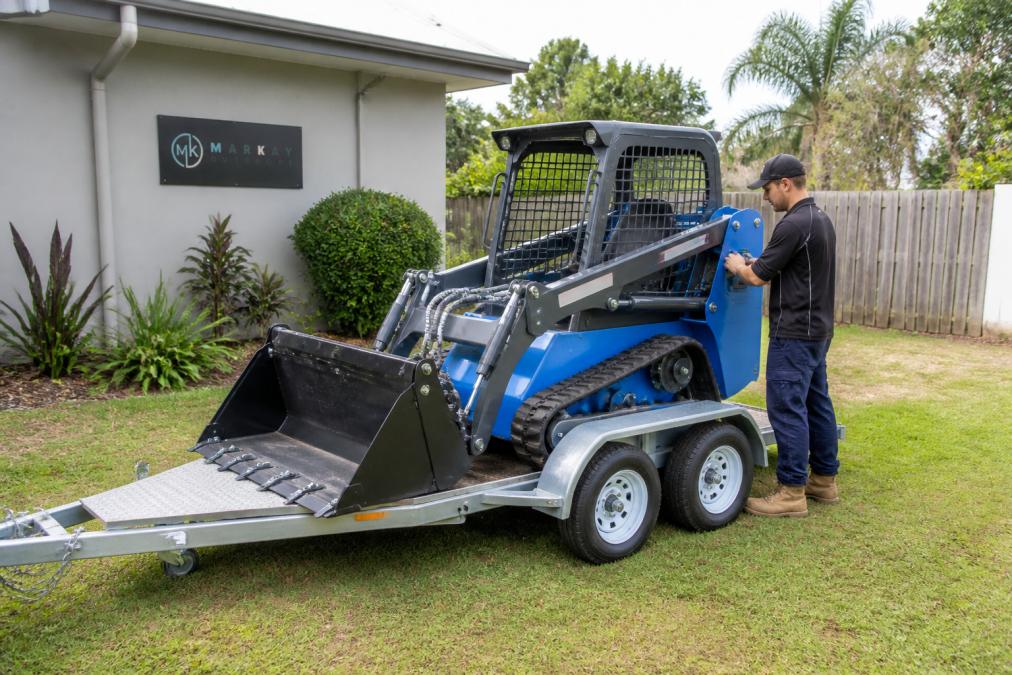
The decision comes down to access versus capability. If the machine can't reach the work area, capability is irrelevant.
Kanga KID KK216: When Access Is the Limitation
The Kanga KID KK216 is approximately 800mm wide, which makes it the pick when a standard machine won't clear the gate. It suits backyard work, narrow side access, and smaller blocks where manoeuvring room is tight.
Attachments include a 4-in-1 bucket, 250mm and 300mm augers, a levelling bar, a cement mixing bowl and a trencher that cuts roughly 100mm wide and up to 600mm deep. That trencher depth suits irrigation and conduit runs rather than deep service trenches.
Where it falls short: if you're moving large volumes over long distances, the smaller frame means more trips. Match it to the job, not the other way around.
PW628: More Capability When Space Allows
The Kanga PW628 Series 6 is the larger machine in the MarKay Outdoors fleet, suited to jobs where access isn't the limiting factor. It runs a 1070mm 4-in-1 bucket, augers in 250mm, 300mm and 450mm, a trencher cutting approximately 150mm wide and up to 900mm deep, and a levelling bar.

That extra trench depth and bucket width matters on fencing runs, drainage and larger ground preparation. If your access is clear and the scope is bigger, this is the machine that finishes the job in a day rather than three.
Step 1: What You'll Need Before You Book
Have four things sorted before you pick up the phone. Skipping any one of them is how bookings go wrong.
- Measured access width at the narrowest point, including gate swing
- A written task list in order of execution
- An honest estimate of material volume and travel distance
- Confirmation of ground conditions: clay, rock, fill or topsoil
- A plan for where the machine will sit overnight
- A tow vehicle and tow ball rated for a loaded trailer
That last point catches people out. Machines supplied on a trailer need a suitable vehicle to move them, and you'll want to confirm your setup before the day.
Step 2: Choose the Right Machine for the Task
Match the attachment to the task first, then the machine to the attachment. This order prevents the classic error of booking a machine that can't run the gear you need.
| Task | Attachment | Typical Machine |
|---|---|---|
| Post holes and fencing | Auger, 250mm to 450mm | Either Kanga |
| Irrigation and conduit | Trencher, 100mm to 150mm wide | Either Kanga |
| Moving soil and gravel | 4-in-1 bucket | Either Kanga |
| Levelling and spreading | Levelling bar | Either Kanga |
| Small concrete batches | Cement mixing bowl | Kanga KID |
| Compacting base and trenches | Plate compactor | Separate hire unit |
Notice the last row. Compaction is a separate machine, and it's the step most DIY projects skip. Loose soil settles, and anything built on it moves.

Step 3: Plan Transport, Access and Setup
Transport and setup decide whether your hire day runs smoothly or burns three hours before you start work.
Confirm your tow vehicle rating, check the trailer lights and tie-downs before you leave, and plan the drop-off point so the machine isn't blocking a neighbour's driveway.
Lawn Renovation Equipment for the Finishing Stage
Lawn renovation equipment handles the part that makes the finished job look finished. Once the ground is shaped and levels are right, the lawn surface needs its own pass.
Dry-Hire Equipment Safety: What You Control on Site
Dry-hire equipment safety sits entirely with the operator. When you hire dry plant, you're the one running it, so the pre-start check, the operating limits and the site conditions are your responsibility.
Run a pre-start before every session:
- Check engine oil, fuel level and hydraulic lines for leaks
- Test the controls through their full range before loading the bucket
- Confirm the attachment is properly locked onto the machine
- Walk the work area for hazards: services, uneven ground, overhead lines
- Check the fuel level at the end of the day so you're not caught short
Common Mistakes to Avoid
The same four mistakes show up on job after job. Avoid them and your hire will run to plan.
Frequently Asked Questions
What is dry-hire and how does it work for landscaping projects?
Dry hire means you hire the machine only and operate it yourself; no operator comes with it. You book a hire period online, collect the equipment (trailer-ready packages make this easier), use it on your project and return it. Fuel is supplied in a full tank and must be returned full, with a refundable fuel bond applying. It suits homeowners, tradies and contractors who are comfortable running compact equipment themselves.
Is it cheaper to hire equipment or buy it for one-off projects?
For a one-off landscaping project, hiring usually works out cheaper than buying because you avoid the purchase price, servicing, storage and resale hassle. Hiring also lets you match the machine to the job, for example a compact mini loader for digging and trenching, then a plate compactor for the paving base, without owning either. If you will repeat the same work many times a year, buying can start to make sense.
What safety precautions should I take when operating hired machinery?
Walk the site first and look for services, slopes, soft ground and overhead lines. Wear appropriate PPE, keep bystanders and pets clear of the work zone, and never carry passengers on a mini loader or compactor. Read the operating information supplied with the machine, check it over before you start, and switch off before refuelling. If anything feels wrong with the equipment, stop and contact the hire provider rather than pushing on.
How do I transport hired compact equipment safely?
Most compact equipment is supplied on a trailer, so you need a suitable tow vehicle, a rated tow ball and coupling, and safety chains correctly crossed. Load and secure the machine with rated straps, check tyre pressures and lights, and keep to a sensible speed. If you are not confident towing, ask about pickup options when booking, and plan your route so you are not reversing into a tight driveway for the first time under pressure.
Getting the equipment right comes down to measuring access, listing your tasks, and matching the machine to the job rather than the job to the machine. MarKay Outdoors supplies dry-hire compact equipment with easy online booking, local pickup and flexible same-day, 24-hour and multi-day hire, so you can pick the right machine for the scope in front of you. Browse the range and lock in your hire dates.