

Table of Contents
- What Affects Mini Loader Hire Cost
- Kanga Mini Loader Hire: PW628 vs KID KK216
- Mini Loader Attachment Guide for Your Project
- Dry Hire Equipment Rates and What's Included
- DIY Landscaping Equipment Beyond the Mini Loader
- Hire Period Options and Cost Breakdown
- Getting Started With Mini Loader Hire
Last Updated: August 30, 2026
What Affects Mini Loader Hire Cost
The cost of hiring a mini loader in Mackay depends on hire duration, machine size, attachments, fuel bonds, and delivery logistics.
Hire duration is the primary cost driver. Same-day pickup costs less than 24-hour hire, which costs less than multi-day or weekly options. Daily rates typically decrease as your hire period extends, making a 7-day hire more economical per day for larger projects.

Machine size and capability matter significantly. The compact Kanga KID KK216 and larger PW628 may have the same daily rate, but the PW628 delivers greater digging depth and bucket capacity. Choosing the right machine prevents overpaying for capability you don't need or underpaying only to discover the smaller unit can't handle your requirements.
Attachment selection adds to total cost. A basic hire includes a standard 4-in-1 bucket, but augers for post holes, trenchers for irrigation lines, or levelling bars for ground prep incur additional charges. Having multiple attachments available on the same machine lets you tackle different project stages without returning to swap equipment.
Fuel bonds are a refundable cost. All hire machines arrive with a full tank and must be returned full. A refundable fuel bond applies to Kanga loaders, so you'll pay this upfront but receive it back if you return the machine with a full tank. Running the machine dry means fuel costs are deducted from your bond before refund.
Delivery and collection logistics affect total spend. Standard hire assumes you collect from Pleystowe and return the equipment yourself. Delivery to your property or collection from a different location incurs additional costs by arrangement.
Kanga Mini Loader Hire: PW628 vs KID KK216
Choosing between the two Kanga mini loaders comes down to access constraints and work scale.
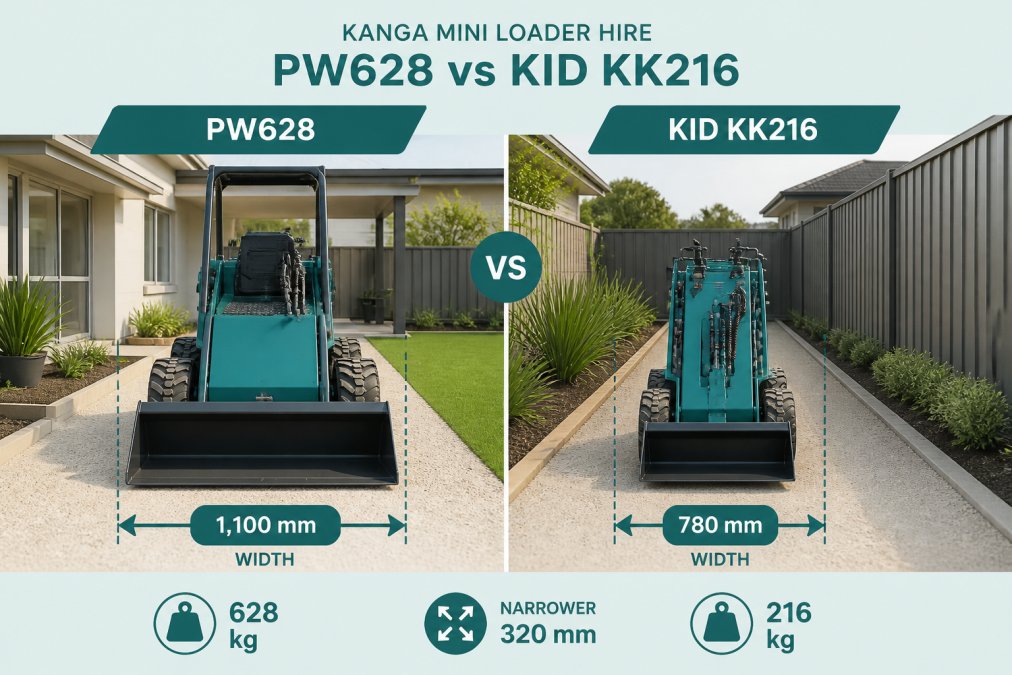
The Kanga PW628 is the larger, more capable option. It suits jobs where access isn't restricted and you need greater digging depth, larger bucket capacity, and the ability to handle tougher ground conditions. The PW628 trencher cuts up to 900mm deep, making it practical for irrigation installation, electrical conduit runs, and deeper site preparation. If your project involves moving substantial soil volumes or working with compacted ground, the PW628's extra power makes it the logical choice. The trade-off is width, at approximately 1.1 metres wide, it won't fit through narrow gates or tight garden pathways.
The Kanga KID KK216 is purpose-built for tight spaces. At only 800mm wide, it squeezes into residential backyards, narrow side passages, and areas where larger machinery won't fit. This makes it the practical choice for most suburban Mackay landscaping projects. The KID handles core tasks, digging, trenching, post holes, levelling, material handling, but with shallower trenching capacity (up to 600mm) and a smaller bucket. Many residential properties have fences, gates, or pathways that prevent larger equipment from reaching the work area. The KID gets there, which means you can actually do the job.

Machine |
Width |
Max Trench Depth |
Best For |
Key Limitation |
|---|---|---|---|---|
PW628 |
~1.1m |
900mm |
Larger jobs, open access |
Won't fit narrow spaces |
KID KK216 |
~800mm |
600mm |
Residential, tight access |
Smaller capacity, shallower reach |
Ask yourself these questions before deciding:
- Can you fit a 1.1 metre-wide machine through every gate and pathway to your work area? If no, the KID is your machine.
- Are you digging deeper than 600mm? If yes, the PW628 is necessary.
- Is this a typical residential backyard project? The KID handles 80% of suburban jobs effectively.
Contact MarKay Outdoors if you're uncertain. Tell them your access width and what you're trying to accomplish; they'll recommend the right machine.
Mini Loader Attachment Guide for Your Project
The attachment you choose determines what your hired mini loader can accomplish. Having the right setup from the start beats discovering mid-project that you need a different attachment.
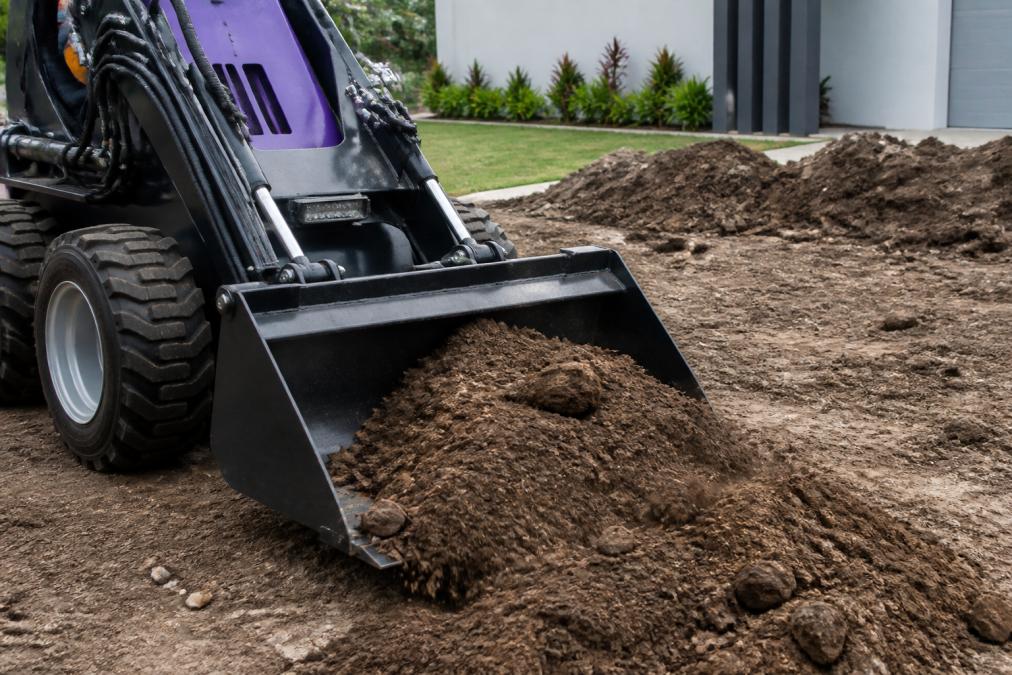
The 4-in-1 bucket is the workhorse attachment. Included with every hire, it handles digging, loading, grabbing, levelling, moving material, and backfilling. For most DIY landscaping projects, clearing garden beds, moving topsoil, levelling ground, removing old turf, the 4-in-1 bucket is all you need.
The auger attachment is essential for post holes and fencing work. Available in 250mm, 300mm, and 450mm sizes, the auger bores holes for fence posts, landscaping anchors, and tree planting. Without an auger, hand-digging post holes in compacted Mackay soil is slow, exhausting work. Hiring the mini loader with an auger transforms a day-long job into an hour.
The trencher cuts narrow, precise lines for services. It digs approximately 150mm wide and up to 900mm deep (PW628) or 100mm wide and up to 600mm deep (KID KK216), making it ideal for irrigation lines, electrical conduit, water pipes, and drainage. The trencher is far faster and more accurate than a shovel.
The levelling bar spreads and grades material. Use it for distributing sand or soil across an area, preparing ground before laying turf, and achieving an even finished surface. It's particularly useful when combined with top dressing or ground preparation work.
Additional attachments available by arrangement include cement mixing bowls, front hoes, rubble buckets, debris pullers, and auger extensions.
Most residential projects use the 4-in-1 bucket and one specialist attachment, typically an auger or trencher. Knowing your project sequence in advance means you can request the right attachment combination when you book.
Dry Hire Equipment Rates and What's Included
MarKay Outdoors operates a dry-hire model, meaning you hire the equipment and operate it yourself. You're not paying for an operator; you're paying for access to the machine.
What's included in your mini loader hire:
- The machine itself, delivered on a trailer
- A full tank of fuel
- Trailer transport to your collection point
- Basic operator support if you haven't used the equipment before
What's not included:
- Operator labour (you operate the machine yourself)
- Fuel beyond the initial full tank
- Additional attachments beyond the standard set (unless specifically booked)
- Delivery to your property (collection from Pleystowe is standard; delivery available by arrangement at additional cost)
- Damage or loss of equipment (you're liable for damage during your hire period)
- Removal of excavated material or waste (you manage clean-up)
The fuel bond system works like this: You pay a refundable fuel bond for Kanga loaders when you hire. The machine arrives with a full tank. You must return it with a full tank. If you do, you get your bond back. If you return it with less fuel, the cost to refill is deducted from your bond.
Hire periods and what they include:
- Same-day hire (pickup and drop-off the same day) includes the full hire period from collection to return
- 24-hour hire runs from collection time through 24 hours later
- Weekend hire runs Friday afternoon through Sunday afternoon
- Multi-day and weekly hires are continuous from collection through your specified return date
What you're responsible for during the hire:
- Operating the machine safely and within its design limits
- Avoiding damage to the equipment
- Returning it clean and with a full tank of fuel
- Identifying and avoiding underground services before operating
- Checking the work area for hazards before starting
The dry-hire model puts responsibility on you, which is why it's affordable. You're not paying for insurance, operator wages, or contractor overhead.
DIY Landscaping Equipment Beyond the Mini Loader
Most landscaping projects benefit from more than just a mini loader. Combining equipment designed for specific tasks often delivers better results than trying to do everything with one machine.
Lawn renovation typically involves multiple stages. If you're tackling a tired lawn, removing thatch, relieving compaction, levelling, and top dressing, hiring purpose-built equipment for each stage transforms the outcome. A dethatcher removes built-up dead grass. A core aerator relieves soil compaction. A top dresser spreads sand or compost evenly. Done in sequence with the right equipment, these steps take a weekend.
Stump removal is a specialist job. If your project includes removing an old tree stump, hiring a stump grinder is far more practical than digging it out by hand or trying to use a mini loader to yank it from the ground.
Soil preparation equipment handles ground conditions specific to Mackay. Mackay's clay-heavy soils often need breaking up before planting or laying turf. A rotary hoe loosens compacted soil and prepares garden beds. A plate compactor firms soil after excavation or trenching, essential for driveways and pathways.

Combining equipment makes sense when your project spans multiple stages, covers a larger area, or you want professional results without hiring a contractor.
Hire Period Options and Cost Breakdown
Choosing the right hire duration depends on your project scope, available time, and how efficiently you work.
Same-day hire suits small, focused jobs. You collect the equipment, complete your work, and return it within the same day. This works for removing a single stump, digging a few post holes, or moving a load of material. It's the lowest-cost option but only practical if your project takes 4-6 hours maximum.
24-hour hire gives you a full day plus flexibility. You can collect in the morning, work through the day, and return the next morning. This works for most residential landscaping projects, garden bed excavation, fence installation, and small ground preparation work.
Weekend hire (Friday afternoon through Sunday afternoon) is designed for two-day projects. If your work requires Friday evening prep and Saturday-Sunday execution, weekend hire makes sense.
Multi-day hire (2, 3, or 7 days) suits larger projects or staged work. If you're doing a complete lawn renovation across multiple days, multi-day hire keeps the equipment on-site and lets you work at a sustainable pace.
7-day hire is economical for extended projects or when you want flexibility. Hire the equipment for a week, work when you can, and return it at the end.
Hire Period |
Best For |
Typical Project Scope |
|---|---|---|
Same-day |
Small, focused jobs |
Single stump, few post holes, material moving |
24-hour |
Most residential work |
Garden bed prep, fencing, ground levelling |
Weekend |
Two-day projects |
Fence installation, moderate landscaping |
2-3 days |
Multi-stage projects |
Lawn renovation, larger ground preparation |
7 days |
Extended or flexible work |
Large landscaping, staged projects, buffer time |
The cost-per-day principle: Longer hire periods have lower daily rates. A 7-day hire costs less per day than a 24-hour hire, so if your project genuinely requires multiple days, booking a longer period is more economical. However, padding your hire period hoping to "get more value" often backfires. Be realistic about how long your project actually takes.
Plan your project sequence before booking. Know what you're doing on day one, day two, and day three. If you're hiring a mini loader plus a dethatcher plus a top dresser for a lawn renovation, coordinate the hire periods so all equipment arrives together.
Weather matters in Mackay. If rain is forecast, it affects ground conditions and your ability to work. Booking an extra day as a buffer makes sense during wet season or if weather is unpredictable.
Contact MarKay Outdoors to discuss your project timeline. They can advise on realistic hire duration and help you avoid both overpaying for unused time and underpaying only to discover you need an extension.
Getting Started With Mini Loader Hire
Booking mini loader hire is straightforward with a few practical steps.
Start by assessing your project scope. What are you actually trying to accomplish? Be specific about access constraints, how wide are your gates and pathways? This determines whether you need the compact KID or the larger PW628.
Identify what attachments you need. If you're installing a fence, you need an auger. If you're trenching for irrigation, you need a trencher. If you're moving soil, the standard 4-in-1 bucket handles it.
Estimate your hire duration realistically. A garden bed excavation takes 2-4 hours. Fence installation takes 6-8 hours. A complete lawn renovation takes 2-3 days. Don't book a 24-hour hire for a 3-hour job, but don't book same-day hire for a 2-day project either.
Check your tow vehicle's capacity. The Kanga loaders arrive on a trailer. Your vehicle must have a minimum 2-tonne towing capacity. Check your vehicle's registration documents if you're unsure. If your vehicle isn't suitable, you'll need to arrange alternative transport or request delivery.
Verify your trailer connection. The hire trailer uses a 7-pin flat plug. If your vehicle has a different connection, adapters are available, but check this before collection to avoid delays.
Book online through MarKay Outdoors. Select your equipment, choose your hire period, and confirm your collection date and time.
Before collection, prepare your work area. Remove obstacles, identify underground services (irrigation, electrical, water lines), and mark areas you want to avoid. Check for hazards like rocks or debris. Walk the path the equipment will take to ensure it fits.
Collect the equipment and review the checklist. The team will walk you through the machine's controls, fuel system, and attachment operation. Ask questions if anything is unclear. Check that all attachments you booked are included before you leave.
Return the equipment with a full tank of fuel. Refill at a local petrol station before returning, not on empty. Return the machine clean and undamaged.
If something goes wrong during your hire, contact MarKay Outdoors immediately. Equipment failure or safety concerns need prompt attention.
Hiring equipment is a practical, cost-effective way to tackle landscaping and property maintenance projects that would otherwise require hiring a contractor or spending weeks doing the work manually. The key is choosing the right machine, planning your project sequence, and working within your hire period.
Frequently Asked Questions
Q: How much does it cost to hire a mini loader for a day?
A: Same-day pickup and drop-off for a Kanga mini loader costs $200, whilst a full 24-hour hire is $200. Weekend and multi-day rates are also available. The exact cost depends on which Kanga model you choose and how long you need it. Contact MarKay Outdoors to check current availability and book your preferred hire period.
Q: What attachments are available for Kanga mini loaders?
A: Both the PW628 and KID KK216 come with a 4-in-1 bucket. Additional attachments such as an auger, trencher, levelling bar, cement mixing bowl, front hoe, rubble bucket and debris puller may also be available depending on your job. Discuss your specific project needs with MarKay Outdoors to confirm which attachments suit your work.
Q: Is dry hire cheaper than hiring an operator?
A: Dry hire means you operate the equipment yourself, which typically costs less than paying for an operator to run the machine for you. With mini loader dry hire, you control the schedule and can complete the work at your own pace. This makes dry hire an affordable option for DIY projects, landscaping and property maintenance when you're comfortable operating the equipment.
Q: What types of projects are suitable for mini loader hire?
A: Mini loaders work well for digging, trenching, post holes, fencing, material handling, site preparation, levelling and landscaping. The Kanga KID is ideal for tight-access residential jobs, whilst the larger PW628 suits jobs with more space and heavier work. Common projects include backyard renovations, drainage installation, stump area clean-up and property maintenance.
This article was written using GrandRanker