

Table of Contents
- Pre-Start Checks Before You Begin Work
- Mini Loader Troubleshooting Guide: Common Fixes You Can Try
- Troubleshooting Rental Equipment on Site: Quick Fault Checks
- How to Report Equipment Faults to Your Hire Company
- When to Stop and Call for Support
- Avoiding Common Mistakes When Troubleshooting Rental Equipment on Site
- Frequently Asked Questions
Last Updated: September 16, 2026
Pre-Start Checks Before You Begin Work
Troubleshooting rental equipment on site starts before the machine is switched on. A structured pre-start check catches most faults before they cost you a day's work, and it takes under ten minutes. At MarKay Outdoors, we hand over every machine with a full tank and a pre-delivery check, but a hire machine still deserves your own walkaround.
Work through this checklist every time:
- Engine oil at the correct level on the dipstick
- Fuel tank full and the tap open
- Coolant and hydraulic fluid within marked ranges
- Air filter housing seated and free of dust
- Tyres or tracks at correct pressure and free of damage
- All hoses and couplings tight, no weeping fittings
- Attachments pinned and locked correctly
- Safety decals legible and guards in place
- Controls return to neutral when released
- No fresh fluid stains under the machine
If something fails here, stop and call the hire company before you leave the yard. It is far easier to swap a machine at pickup than mid-job.
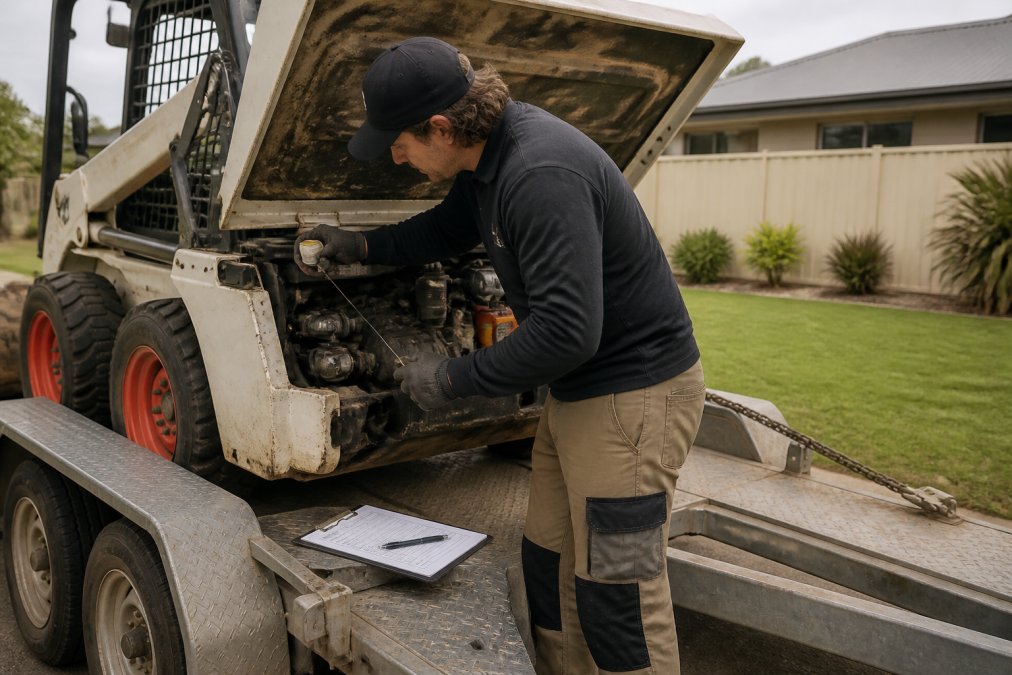
Mini Loader Troubleshooting Guide: Common Fixes You Can Try
A mini loader that won't start or won't move is usually a simple issue, not a mechanical failure. This mini loader troubleshooting guide covers the faults you can safely diagnose yourself, and the point where you should stop.
Machine cranks but won't fire. Check the fuel tap, the fuel level and the safety interlocks. Most mini loaders will not start unless the operator presence lever or seat switch is engaged and all controls are in neutral.
Machine won't crank at all. Check the battery terminals for corrosion, confirm the isolator is on, and test that the park brake or neutral switch is where the manual specifies.
Hydraulics sluggish or dead. Confirm the auxiliary circuit is engaged and the attachment coupling is fully seated. A partially connected quick-hitch will starve the circuit.
Machine creeps or drifts. Stop immediately. This points to a hydraulic or brake issue that is not a user fix.
The Kanga KID KK216 is only 800mm wide and suits tight-access backyards, while the larger PW628 handles bigger material-moving jobs. Both are supplied on a trailer with attachments, so confirm every attachment is pinned before you start.

Troubleshooting Rental Equipment on Site: Quick Fault Checks
Troubleshooting rental equipment on site follows a simple order: fuel, battery, safety interlocks, then hydraulics. Working in that sequence rules out the common causes before you touch anything mechanical.
When a fault appears mid-job, run these checks in order:
| Symptom | First Check | Likely Cause | Your Action |
|---|---|---|---|
| Won't start | Fuel tap and level | Fuel starvation | Refuel, open tap, retry |
| No crank | Battery terminals | Loose or corroded connection | Clean and tighten |
| Dies under load | Air filter | Dust blockage | Tap out filter, refit |
| Attachment won't move | Quick-hitch coupling | Not fully seated | Reseat and lock pin |
| Overheating | Coolant and radiator fins | Blocked or low coolant | Stop, let cool, call hire company |
| Vibration or noise | Attachment pins | Loose fitting | Stop and inspect |
For a plate compactor that won't fire, check the fuel tap and the oil alert sensor, since many units shut down automatically when oil is low. For a generator, confirm the overload breaker has not tripped before assuming a fault.

If a check clears the fault, log what you did. If it does not, stop and call for support.
How to Report Equipment Faults to Your Hire Company
How to report equipment faults well comes down to three things: what the machine is doing, when it started, and what you have already checked. A clear report gets you a faster resolution than a vague phone call.
Have this information ready before you ring:
- Machine model and the hire agreement number
- The hour meter reading at the time of the fault
- A plain description of the symptom, not your diagnosis
- What you have already checked and any fluid you added
- Photos or a short video of the fault
- Your location and whether the machine is blocking a job
Be honest about what happened. If the machine was overloaded, clipped or run low on oil, say so. A hire company can usually work with an honest report far better than a fault that only appears after the machine is back in the yard.
Ask directly: can the fault be fixed on site, do you need to swap the machine, or should you return it? Get the answer before you commit to another day's hire.
PW628 Kanga Mini Loader Hire Mackay →
When to Stop and Call for Support
Stop work immediately when a fault involves a safety system, a fluid leak, structural damage, or anything you cannot identify. Pushing a suspect machine through a job risks injury and turns a minor repair into a major one.
Call for support rather than continuing if you see any of these:
- Brakes that grab, slip or fail to hold
- Steering that pulls or locks
- Hydraulic fluid spraying or pooling under the machine
- Smoke, burning smell or unusual heat from the engine bay
- Cracked welds, bent rams or damaged attachment mounts
- Any warning light or alarm you cannot clear
- A machine that has tipped, been struck or dropped a load unexpectedly
Equipment that is clearly unsafe to operate should be shut down, isolated and left where it sits. Do not attempt a roadside repair on a hydraulic system under pressure.
If you are unsure whether a fault is serious, treat it as serious. A quick call costs you minutes; a failure on site can cost you the job.
Avoiding Common Mistakes When Troubleshooting Rental Equipment on Site
The biggest mistake people make is guessing at a fix instead of reading the manual. Every hire machine comes with an operator manual, and the fault codes, fluid specs and safety interlocks are all listed there.
Other mistakes we see regularly:
Forcing a machine that won't start. Repeated cranking flattens the battery and can flood the engine. Check the basics first.
Adding the wrong fluid. Topping up with whatever is in the shed risks damage that is not covered by the hire agreement.
Ignoring the fuel bond terms. Machines are supplied with a full tank and must be returned full. If not, fuel costs are deducted from the bond.
Running past the point of a fault. A small hydraulic weep becomes a burst hose if you keep working. Stop early.
Frequently Asked Questions
What should I do if my hired mini loader stops working?
Stop the machine, lower any attachments to the ground and switch off the engine. Check the obvious causes first: fuel level, the fuel tap position, the safety cut-off and whether the machine is on level ground. If it still won't start, don't keep cranking it. Contact the hire company, describe what happened and what you checked, and ask for guidance before trying anything further. Prompt reporting usually means a faster fix.
Are there common issues with stump grinders I can fix myself?
You can safely check the drive belt tension if it's accessible and the machine is switched off, and clear loose debris from around the cutting wheel with the machine off and the spark plug lead removed. Never put hands or tools near the teeth while the machine could turn over. Anything involving the engine, the teeth themselves or a slipping belt should be reported to the hire company rather than fixed on site.
Who is responsible for repairs on dry-hire equipment?
With dry hire, you operate the machine but the hire company remains responsible for repairs and mechanical faults that aren't caused by misuse. Your job is to use the equipment as instructed, keep it fuelled and checked, and report problems promptly. If damage comes from misuse or running the wrong fuel, responsibility typically shifts to you, so report faults early and don't attempt repairs yourself.
How do I safely check a machine for blockages or minor faults?
Switch off the engine, remove the key where possible and wait for all moving parts to stop before inspecting anything. On machines like a plate compactor or trencher, clear material only with a suitable tool, never your hands. Wear gloves and eye protection, and check that the machine can't roll or move. If a blockage won't clear easily, leave it and contact the hire company.
When should I stop using rental equipment and call for support?
Stop immediately if you see smoke, hear unusual noises, smell burning, notice a fuel or oil leak, or if a safety feature isn't working. Continuing to run a machine with these symptoms risks injury and further damage. Switch it off, make it safe, and call the hire company. For anything you're unsure about, it's always better to ask than to keep operating.
What are the basic safety checks before operating hired machinery?
Walk around the machine and look for leaks, loose fittings or damage. Check fuel and oil levels, tyre or track condition, and that guards and safety switches are in place. Confirm the controls work before you start work, and make sure you know where the emergency stop is. If anything looks wrong, don't operate the machine and contact the hire company first.