

Table of Contents
- DIY Backyard Landscaping Tips 2026: Start With a Plan
- When Mini Loader Hire Beats a Wheelbarrow
- Lawn Renovation Tips for Tired, Compacted Yards
- Core Aeration Benefits Most Homeowners Miss
- Stump Grinder Safety: Rules Before You Start the Engine
- Choosing Equipment Hire Over Buying for One-Off Jobs
- Frequently Asked Questions
Last Updated: September 19, 2026
DIY Backyard Landscaping Tips 2026: Start With a Plan
Most backyard projects stall before a single shovel hits the ground, and it's rarely the digging that stops them. Many hire trailers leave the yard and come back half-used, and the pattern is almost always the same: no plan, no sequence, no realistic budget. Good backyard landscaping starts on paper.
Backyard landscaping is the process of planning, shaping and improving the outdoor areas of a residential property, including lawns, garden beds, paths, drainage and structural features. It rewards preparation far more than brute force.
Below, we'll show you how to map your block, sequence your projects so one job doesn't undo the last, and decide when hiring compact equipment saves you days rather than dollars.
Map Your Block and Set a Realistic Budget
Start by measuring. Walk the block with a tape and a phone, and note boundaries, slope, drainage lines, existing services, tree positions and where water pools after rain. Most councils hold property and planning information you can check before you commit to a layout, and Queensland Government planning and building information is a sensible starting point for anything structural.
Budget honestly, and split it into three buckets: materials, hire, and contingency. The contingency bucket is the one people skip, and it's the one that saves a project when a retaining wall turns out to need more concrete than expected.
- Measured block plan with slope and drainage notes
- List of existing services, trees and structures
- Material quantities calculated, not guessed
- Hire window booked around your own availability
- Contingency set aside before work begins
Sequence Your Projects in the Right Order
Order matters more than effort. Work from the ground up and from the outside in: clear and level first, then drainage, then structural elements, then soil preparation, and only then turf, planting and finishing touches.
Get this wrong and you'll be redoing work. Lay turf before you've fixed drainage and you'll be lifting it again. Build a garden bed before you've run the trench for irrigation and you'll be digging through your own handiwork.
A simple sequence that holds up for most residential blocks:
- Clear, strip and level the working area
- Install drainage and any sub-surface services
- Build retaining, edging and hard surfaces
- Prepare and amend soil
- Lay turf or plant
- Finish with mulch, toppings and clean-up
When Mini Loader Hire Beats a Wheelbarrow
Mini loader hire beats a wheelbarrow the moment volume, repetition or access becomes the constraint. A wheelbarrow moves roughly one barrow per few minutes over short distances; a compact loader moves bucket after bucket without the same physical toll, and it fits through standard gateways.
For most residential jobs in and around Mackay, the tipping point is somewhere around a few cubic metres of material, or any task that repeats more than a couple of dozen times. Moving soil, spreading gravel, carting mulch, lifting sleepers, augering post holes: all of these are loader work, not barrow work.
That's the practical case for Safe Work Australia's guidance on managing physical risks in manual tasks. Repetitive manual handling is where DIY projects cause injuries, and it's also where they run out of momentum.
Attachments That Do the Heavy Lifting
The machine is only half the decision. Attachments turn one hire into several jobs, and they're usually the difference between a job taking a weekend and a job taking a fortnight.
| Attachment | Typical Job | Why It Saves Time |
|---|---|---|
| Bucket | Moving soil, gravel, mulch | Replaces dozens of barrow loads |
| Auger | Post holes, planting | Consistent depth and diameter |
| Trencher | Irrigation, drainage, cabling | Straight, even trench in one pass |
| Forks | Sleepers, pavers, pallets | Lifts what two people shouldn't |
If you're working on a tight residential block, a compact Kanga mini loader is usually the right size rather than something larger.
LawnHub Amateur Pack – DIY Lawn Care →
Lawn Renovation Tips for Tired, Compacted Yards
Lawn renovation is the process of restoring a tired or compacted lawn by removing built-up thatch, relieving soil compaction and reintroducing material to level and feed the surface. It's the highest-return work you can do on an established yard.
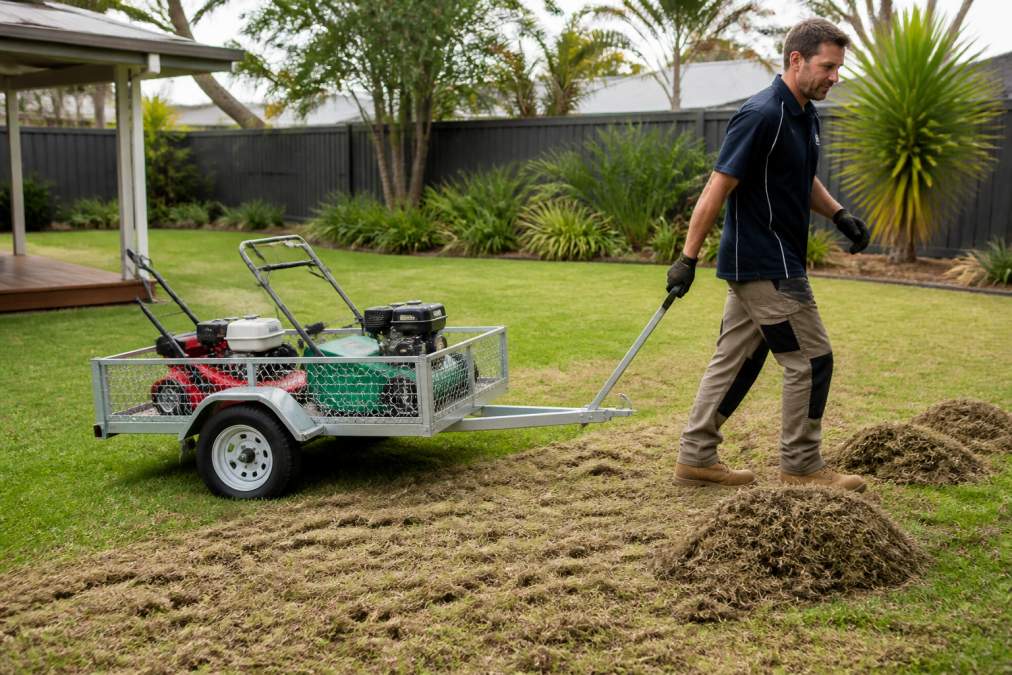
The Right Order: Mow, Dethatch, Aerate, Topdress
Do the four stages in order, and don't skip a step to save a day.
- Mow the lawn appropriately for the renovation you're carrying out.
- Dethatch to remove excessive thatch and unwanted surface material.
- Clean up the removed material with rakes and bags.
- Core aerate compacted areas to open the soil around the root zone.
- Topdress and level where the lawn is uneven or needs material added.
Core Aeration Benefits Most Homeowners Miss
Core aeration removes small plugs of soil from the lawn to relieve compaction and open pathways for air, water and nutrients to reach the root zone. The benefit people miss isn't the holes, it's what happens underneath them.
Stump Grinder Safety: Rules Before You Start the Engine
Stump grinder safety comes down to four rules: know what's underground, know where the debris goes, keep everyone well clear, and wear the right protection. Grinders throw material at speed, and a stump is never just a stump.
Set up properly:
- Establish an exclusion zone of at least several metres and keep children and pets inside
- Wear eye and hearing protection, gloves and sturdy boots, with no loose clothing
- Direct the discharge away from vehicles, windows, fences and people
- Work from the side of the wheel, never in line with the cutting arc
- Switch off and let the wheel stop completely before clearing debris
Choosing Equipment Hire Over Buying for One-Off Jobs
Hire wins for one-off jobs almost every time. A stump grinder, aerator or top dresser used once a year costs more to own, service, store and maintain than it does to hire for the day you actually need it.
| Job | Best Hire Option | Typical Hire Window |
|---|---|---|
| Stump removal | Stump grinder | Same-day or 24-hour |
| Thatch and compaction | Dethatcher plus core aerator | Same-day or 24-hour |
| Levelling and topdressing | Sand spreader and top dresser | Same-day or 24-hour |
| Digging, carting, augering | Mini loader with attachments | 24-hour or multi-day |
Frequently Asked Questions
How can I plan a backyard renovation on a budget?
Start by listing what you want to change, then sort those jobs into stages so you are not paying for equipment twice. Hire only the machines you cannot justify buying, such as a rotary hoe for breaking up clay, and group jobs that use the same machine into one hire period. A same-day lawn aerator and trailer hire is $190, while 24-hour hire is $240, so batching work into a single day keeps costs down. Do the soil preparation properly the first time and you avoid redoing it later.
What are the best tools for DIY backyard projects?
It depends on the job. For soil preparation, a rotary hoe breaks up compacted clay and old turf before you lay new garden beds. For lawn work, a dethatcher and core aerator handle thatch removal and compaction in one pass. For moving soil, gravel or mulch, mini loader hire saves hours of wheelbarrow work, especially on larger blocks. For spreading sand or topdressing across a lawn, a self-propelled top dresser covers ground far faster than shovel and rake.
How do I prepare my soil for new turf or garden beds?
Clear the area first, then break up the top layer so roots and water can move through it. A rotary hoe is the quickest way to loosen compacted soil, blend in conditioners and work old turf back into the ground. Once the soil is broken up, level it and firm it lightly before laying turf or planting. If the ground is heavy clay, working in organic matter at this stage makes a noticeable difference to how the new lawn or beds establish.
Is it better to hire equipment for backyard projects?
For one-off or seasonal jobs, hiring usually makes more sense than buying. A core aerator, dethatcher or stump grinder might only be needed once or twice a year, so storing and maintaining one rarely pays off. Hire also gives you access to commercial-grade machines that do the job faster and more consistently than cheaper consumer tools. MarKay Outdoors offers flexible same-day, 24-hour and multi-day hire so you only pay for the time you actually need.
How do I safely remove old stumps or clear ground?
Stump grinder safety starts before the machine does. Wear eye and ear protection, clear the area of rocks, wire and debris, and check for underground services before grinding. Keep bystanders, children and pets well back, and never reach into the grinding area while the engine is running. Let the grinder do the work at a steady pace rather than forcing it. Once the stump is ground down, backfill the hole with the grindings or fresh soil and level it off.
What are the top landscaping trends for 2026?
Practical, low-maintenance yards are leading the way. Homeowners are choosing native and drought-tolerant planting, defined garden beds instead of large lawn areas, and better soil preparation upfront to reduce ongoing work. Lawn renovation is also a focus, with core aeration and topdressing used to revive tired grass rather than replacing it. Hiring compact equipment for the preparation stage lets DIY renovators tackle bigger jobs without buying machinery they will rarely use again.