

Table of Contents
- Why Mini Loader Hire Makes Sense for Residential Blocks
- Kanga Loader Hire: Two Sizes for Mackay Backyards
- Mini Loader Attachment Guide for Common Home Jobs
- Getting a Mini Loader Through a Standard Side Gate
- Compact Equipment Safety Tips for First-Time Operators
- Planning Your Hire: Transport, Duration and Booking
- Book Your Mini Loader Hire for Your Residential Project
- Frequently Asked Questions
Last Updated: September 5, 2026
Why Mini Loader Hire Makes Sense for Residential Blocks
Tackling a landscaping project on a standard residential block often comes down to one stubborn problem: the machinery that would make the job easy simply will not fit through the gate. Mini loader hire for residential blocks solves that problem by putting compact, capable machines in your hands without the cost of full-size earthmoving equipment. At MarKay Outdoors, we provide these machines for everything from digging footings to clearing away old garden beds.
A mini loader is a small, skid-steer style machine designed for tight spaces. Its real advantage is the range of attachments available, which lets one machine handle digging, trenching, levelling and hauling across a weekend. Instead of hiring several single-purpose tools or paying a contractor for days of work, you operate the machine yourself and keep the project moving on your schedule.
The key is matching the machine to your block. A standard suburban yard with narrow side access needs a different machine than an acreage with open space. Below, we break down the two Kanga mini loaders in our Mackay hire fleet, the attachments that suit common home jobs, and how to get the machine onto your site safely.
Kanga Loader Hire: Two Sizes for Mackay Backyards
The two Kanga models available for Kanga loader hire through MarKay Outdoors cover most residential situations, from a tight inner-city yard to a larger rural block. Both are supplied on a trailer ready for pickup, and both are dry-hire, meaning you operate them yourself with our guidance on safe use.
The main difference is width and power. The smaller machine slips through gaps that would stop the larger unit cold, while the bigger machine moves more material per pass on open ground. Choosing correctly comes down to measuring your access points first, then matching the machine to the work.
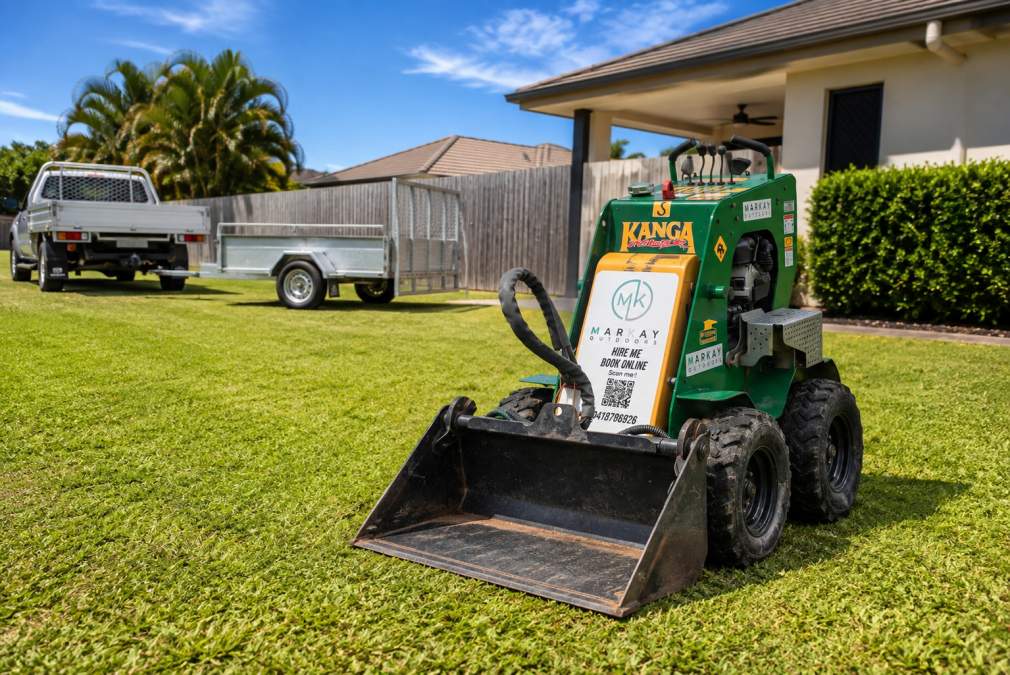
Kanga KID KK216 mini loader hire equipment parked on a residential lawn with a ute and trailer in a sunny Queensland garden.
Kanga KID KK216: The Tight-Access Specialist
The Kanga KID KK216 is the machine to choose when access is the main concern. At only 800mm wide, it fits through a standard side gate, which makes it the practical option for fenced backyards where larger machinery cannot physically get to the work area.
This model suits homeowners, landscapers and tradies tackling digging, trenching and smaller earthmoving jobs on residential blocks. It is also a sensible choice for anyone hiring a mini loader for the first time, as its smaller size is easier to control in confined spaces.
Kanga PW628: More Power for Open Sites
When access is not restricted and you have more ground to cover, the Kanga PW628 Series 6 is the larger Kanga in our fleet. It delivers more capability for jobs where you need greater digging force or want to move larger volumes of material without spending all day on it.

The PW628 is the better fit for open backyards, acreage blocks and site preparation work where you can drive the machine straight in. If you have a big excavation or a long trench to dig and the access to support a larger machine, this model will save you noticeable time over the smaller unit.
Mini Loader Attachment Guide for Common Home Jobs
A mini loader attachment guide is really where the value of hiring one of these machines becomes clear. The loader itself is the workhorse, but the attachments turn it into a specialised tool for each stage of your project.
For common residential jobs, a few attachments do most of the work:
- Digging and trenching: A bucket attachment digs footings for retaining walls, fences and garden edges, and clears soil for paths and paving.
- Post holes: An auger attachment drills clean, consistent holes for fence posts and deck footings far faster than a manual post-hole digger.
- Levelling and spreading: A level bar or blade attachment spreads soil, sand and gravel evenly, which is useful when preparing a base for turf or a shed pad.
- Hauling and cleanup: The bucket also moves rubble, old garden waste and excavated soil to a skip or trailer for disposal.
The practical benefit is that one hire covers multiple stages of a project. You might dig footings on Saturday morning, switch to the auger for post holes after lunch, then use the bucket to backfill and clean up before you finish.
Getting a Mini Loader Through a Standard Side Gate
The question we hear most from Mackay homeowners is whether these machines actually fit through a standard side gate. The answer depends on the model and your gate width, so measure before you book.
A typical residential side gate opening is between 800mm and 1000mm wide. The Kanga KID KK216, at 800mm wide, is designed to clear that opening, which is exactly why it is the go-to choice for fenced backyards. The larger PW628 needs a wider opening or direct access from the front of the property.

A common mistake is assuming the gate width is the only measurement that matters. Check the path from the street to your work area for tight corners, low branches and narrow gaps between the house and fence. Also confirm the ground is firm enough to support the machine, especially after rain, as a mini loader is heavy and can sink into soft lawns.
Compact Equipment Safety Tips for First-Time Operators
Operating a mini loader is straightforward, but it deserves respect. These compact equipment safety tips apply whether you are an experienced tradie or hiring a machine for the first time.
Start by reading the operator's manual supplied with the machine and doing a visual check of the unit before you begin. Confirm the attachments are locked in correctly and look for any obvious damage or loose fittings. If anything seems wrong, stop and contact us rather than pushing on.
When operating, keep these principles in mind:
- Move slowly on slopes and avoid side-on travel on any incline.
- Keep the bucket low when driving to maintain stability.
- Watch for underground services before digging, and arrange a dial-before-you-dig search if you are unsure what lies beneath.
- Keep children and pets well clear of the work area at all times.
- Never carry passengers on the machine or in the bucket.
On a residential block, the biggest risks are usually underground pipes and uneven ground, not the machine itself. Slow, deliberate operation avoids most problems. If you have never used a mini loader before, start with lighter tasks to build confidence before tackling the main excavation.
Planning Your Hire: Transport, Duration and Booking
Getting the most from your hire comes down to planning the logistics as carefully as you plan the digging. Both Kanga models are supplied on a trailer, which means you need a vehicle capable of towing the loaded trailer, and you should confirm your towbar and hitch ratings before booking.
For duration, think about the full scope of work, not just the main task. A weekend hire from MarKay Outdoors suits most residential projects, and we offer flexible same-day, 24-hour and multi-day options. If you are hiring attachments for several different jobs, allow enough time to switch between them without rushing.
Booking ahead is wise, particularly before a long weekend or during peak landscaping season. Our online booking system makes the process straightforward, and local pickup in Mackay means you can collect the machine and get started the same day.
Hire Consideration |
What to Check |
Why It Matters |
|---|---|---|
Access route |
Gate width, corners, overhead branches |
Machine must physically reach the work area |
Towing capacity |
Towbar and hitch ratings for loaded trailer |
Safety and legality on the road |
Ground conditions |
Firm, dry ground on the route and site |
Prevents the machine sinking or getting stuck |
Job scope |
Full list of tasks and attachments needed |
Ensures you book enough time |
Book Your Mini Loader Hire for Your Residential Project
Mini loader hire for residential blocks gives Mackay homeowners and tradies the capability to complete digging, trenching and site preparation work efficiently, without the expense of full-size earthmoving equipment. Choose the 800mm-wide Kanga KID KK216 for tight side-gate access, or the larger PW628 when you have open space and need more power.
At MarKay Outdoors, we make the process simple with easy online booking, local pickup and well-maintained equipment ready to go. Our team can help you confirm which machine suits your block and what attachments you will need for the job ahead.
Frequently Asked Questions
Can a mini loader fit through a standard residential side gate?
The Kanga KID KK216 is only 800mm wide, which means it fits through most standard residential side gates. Before you book, measure your gate opening and any narrow pathways to the work area. Remember to account for the width of the bucket or attachment you plan to use, as some add width. If access is tight, the Kanga KID is the model to choose over the larger PW628.
What types of attachments are available for mini loader hire?
Mini loaders accept a range of attachments that turn one machine into a versatile tool. Common options include buckets for digging and moving material, augers for drilling post holes, and trenchers for drainage or irrigation lines. Check the attachment guide on the MarKay Outdoors website to confirm which implements suit the Kanga KID KK216 and PW628, and match the attachment to your specific job before booking.
Is it difficult to operate a Kanga mini loader for a beginner?
Kanga mini loaders are designed with simple, intuitive controls that most first-time operators pick up quickly. The machines are compact and stable, which helps when you are learning on a residential block. Before you start, walk the site to spot hazards, and practise basic movements in an open area. The MarKay Outdoors team can talk you through the controls at pickup so you feel confident before you begin.
What safety gear is required when operating a mini loader?
At a minimum, wear sturdy boots with good grip, gloves, and eye protection. Hearing protection is recommended because the machine runs loudly. If you are working in dusty conditions, a dust mask is sensible. Steel-capped boots are a smart choice for site work. Your compact equipment safety checklist should also include checking the ground for underground services before you dig, and keeping bystanders well clear of the work area.
This article was written using GrandRanker