

Table of Contents
- What You'll Need Before You Choose a Stump Grinder
- Types of Stump Grinders and Which Suits Your Site
- Key Factors When Choosing a Stump Grinder
- How to Operate a Stump Grinder Safely and Effectively
- Stump Grinder Safety Tips for DIY Operators
- Stump Grinder Rental Duration: How Long Will You Need It?
- Frequently Asked Questions
Last Updated: September 15, 2026
What You'll Need Before You Choose a Stump Grinder
Choosing the right stump grinder starts long before you look at a machine. It starts with measuring the job in front of you. This guide from MarKay Outdoors walks through the exact checks we recommend to anyone deciding how to choose the right stump grinder for their block, whether it's a single backyard stump or a row of them along a fence line.

Get these two measurements wrong and you'll either hire a machine that won't fit through the gate or one that takes all weekend to grind a stump a bigger unit would handle in an hour.
Measure the Stump and Check Access
Stump diameter drives everything. Measure across the widest point of the stump at ground level, not the height of what's left standing.
Then check access. A walk-behind grinder needs a gate opening of roughly 700mm to 900mm, depending on the model, while a tow-behind unit needs a driveway or open lawn to reach the stump. Walk the path yourself and note tight corners, steps, garden beds and overhead branches.
Identify the Timber and Root Spread
Softwoods like pine grind faster than hardwoods such as ironbark or gum, which have denser grain and blunt teeth quicker.
Root spread matters too. Surface roots extending from the stump mean you'll need to grind wider than the stump itself, or plan to cut them back separately. If you're unsure of the species, a local expert can usually identify it from a cross-section of the cut timber.
Types of Stump Grinders and Which Suits Your Site
Two machine styles cover almost every residential and trade job: walk-behind and tow-behind. Walk-behind grinders are the practical choice for tight residential blocks, while tow-behind units suit larger properties with clear access and multiple stumps to clear.
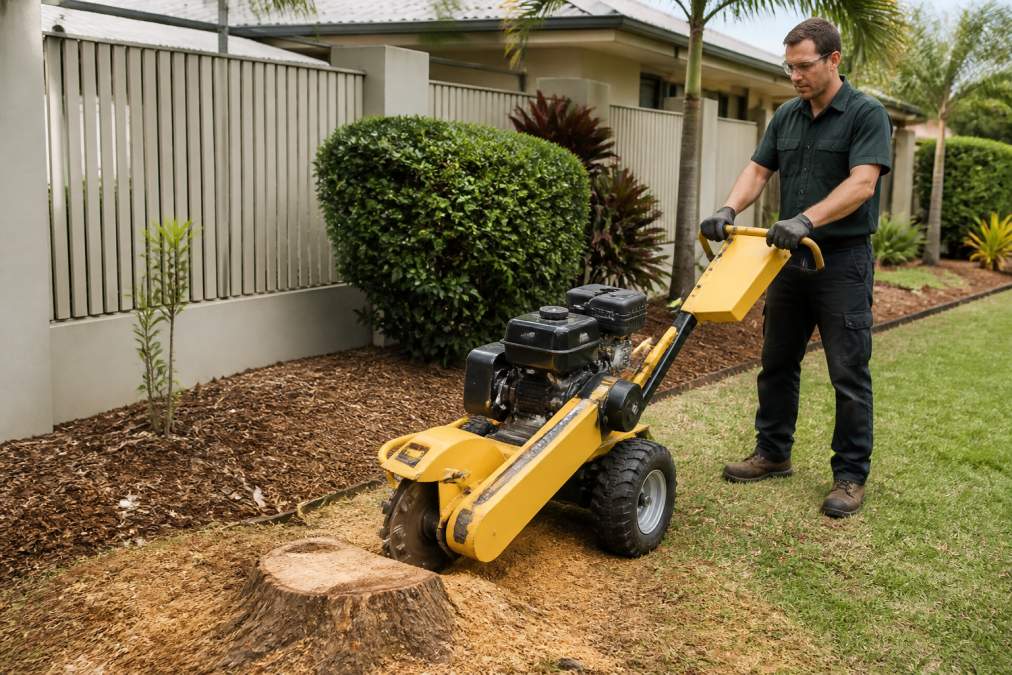
Walk-Behind vs Tow-Behind Machines
Walk-behind units are compact and manoeuvrable, which makes them the better fit for backyard jobs behind a standard gate. You steer them by hand, so they suit smaller stumps and tighter spaces.
Tow-behind grinders are heavier, cut faster and handle bigger stumps, but they need vehicle access and more open ground to work in. If your stump sits in a fenced backyard with no vehicle access, a walk-behind machine is usually the only realistic option.
| Machine Type | Best For | Access Needed | Manoeuvrability |
|---|---|---|---|
| Walk-behind | Backyard stumps, tight gates | 700-900mm gate opening | High |
| Tow-behind | Multiple or large stumps | Vehicle access, open ground | Low |
Key Factors When Choosing a Stump Grinder
Power source, cutting depth and grind height are the three specifications that decide whether a machine can actually finish your job. Get these right and the rest is straightforward.
Power Source, Cutting Depth and Grind Height
Petrol engines remain the standard for hire machines because they deliver consistent torque without needing a power point on site. Cutting depth determines how far below ground level the machine can grind, which matters if you plan to replant or lay turf over the area.
Grind height is the height of the cutting wheel above ground, and it affects how low you can take the stump. A machine with adjustable depth control gives you more flexibility to grind below the surface rather than leaving a raised crown.
How to Operate a Stump Grinder Safely and Effectively
Operating a stump grinder well comes down to controlled passes, not force. Let the cutting wheel do the work and move the machine in slow, deliberate sweeps across the stump face.
Start at one edge and work across in overlapping passes, lowering the wheel gradually with each sweep. Rushing the pass or pushing the wheel too hard into the timber overheats the teeth and slows the whole job down. Keep the area behind the machine clear, since the wheel throws debris backwards.
Stump Grinder Safety Tips for DIY Operators
Stump grinder safety tips matter most for first-time operators, and the basics are non-negotiable. Wear eye and ear protection, sturdy boots, and close-fitting clothing with no loose cuffs or drawstrings.
Clear the work area of rocks, wire and metal debris before you start, since these can be thrown by the cutting wheel. Keep bystanders, children and pets well back, and never reach into the cutting zone while the engine is running.
- Check the cutting teeth for damage before starting
- Confirm the area is clear of rocks, wire and debris
- Wear eye, ear and foot protection
- Keep bystanders at a safe distance
- Never leave a running machine unattended
- Switch off and let the wheel stop fully before inspecting
Stump Grinder Rental Duration: How Long Will You Need It?
Stump grinder rental duration depends on stump size, species and access, not on a fixed rule. A single small softwood stump often takes under an hour of grinding time, while a large hardwood stump with surface roots can take several hours.
Factor in setup, repositioning and clean-up when you plan your hire window. If you're clearing multiple stumps, a full-day hire is usually more practical than trying to squeeze the job into a few hours.
Most hire businesses offer flexible same-day, 24-hour and multi-day options, so match the window to the job rather than guessing short and running out of time.
| Job Size | Typical Grinding Time | Suggested Hire Window |
|---|---|---|
| Single small stump | Under 1 hour | Same-day |
| Single large hardwood stump | 2-4 hours | 24-hour |
| Multiple stumps on one block | Half to full day | Multi-day |
Deciding how to choose the right stump grinder comes down to measuring the job honestly: stump size, access, species and how many you're clearing. MarKay Outdoors makes that decision easier with straightforward dry hire, easy online booking, local pickup and flexible same-day, 24-hour and multi-day hire, plus trailer-ready equipment packages so you can get the machine to site without fuss. For stumps around the yard, our Stump Grinder Hire Mackay | 15HP Stump Grinder & Trailer is built for exactly this kind of job. Get started with MarKay Outdoors and book the right machine for your next clean-up.
Frequently Asked Questions
What size stump grinder do I need for my yard?
Match the machine to your stump diameter and access. Measure across the widest part of the stump at ground level. A compact walk-behind stump grinder suits stumps up to roughly 300mm across on residential blocks, while larger tow-behind machines handle bigger stumps and multiple removals. If your access is narrow, a walk-behind unit is easier to manoeuvre through gates and tight spaces.
Is it better to hire a stump grinder or pay for removal?
Hiring lets you operate the machine yourself, which suits homeowners who want to control the timing and do the work on their own schedule. A 15HP petrol stump grinder with a carbide-toothed cutting wheel can grind most residential stumps progressively without digging them out by hand. If you prefer not to operate machinery, you would need to arrange a separate contractor, but hiring keeps the job in your hands.
What safety gear is required when operating a stump grinder?
Wear eye and ear protection, sturdy boots, gloves and close-fitting clothing with no loose fabric. Clear the work area of rocks, wire and debris that could become projectiles, and keep bystanders and pets well back. Check the cutting teeth and guards before starting, and never reach into the cutting zone while the engine is running. A dust mask helps when grinding dry timber.
What should I check before hiring a stump grinder?
Confirm the stump diameter and site access first, then check the machine's cutting depth and width against your job. Ask about the fuel type, trailer requirements and whether teeth are sharp. Book ahead for weekends, and allow enough rental duration for setup, grinding and cleanup. A quick phone call to the hire team can confirm the right machine for your stump size and access.