

Table of Contents
- What Is Top Dressing a Lawn Used For
- Key Benefits of Top Dressing Your Lawn
- Lawn Aeration and Top Dressing: A Complete Renovation Strategy
- How to Use a Top Dresser for Best Results
- DIY Lawn Levelling Techniques With Top Dressing
- Choosing the Right Top-Dressing Materials
- Getting Started With Equipment Hire
- Frequently Asked Questions
Last Updated: September 28, 2026
What Is Top Dressing a Lawn Used For
What is top dressing a lawn used for? It's the practice of spreading a thin layer of quality material, typically sand, compost, or a blended mix, across your grass to improve soil structure, level uneven areas, and support overall lawn health. It's one of the most effective ways to renovate an established lawn without starting from scratch.
MarKay Outdoors provides equipment to help Mackay homeowners and contractors tackle lawn renovations. Top dressing works because it addresses problems at the root level. Compacted soil, bare patches, and uneven surfaces don't fix themselves. A good top dressing program, paired with aeration and dethatching, transforms tired lawns into healthy, level turf.
The key benefit is that top dressing improves what's already there. You're not replacing your lawn, you're feeding and levelling it.
Key Benefits of Top Dressing Your Lawn
Top dressing delivers several practical advantages that make it worth the effort.
Levels uneven surfaces. Low spots, bumps, and dips become trip hazards and create drainage problems. Top dressing fills these voids gradually. A few passes with the right material smooths out minor variations.
Improves soil structure. Over time, foot traffic and weather compact soil. This reduces pore space, making it harder for water, oxygen, and nutrients to reach grass roots. Adding quality top-dressing material loosens the soil profile and creates better conditions for root growth.
Encourages thicker, healthier grass. When roots can access air and nutrients more easily, grass grows stronger. Thicker turf crowds out weeds and recovers faster from wear.
Reduces reliance on fertiliser. A good top-dressing mix often contains organic matter that feeds the soil naturally. This means less chemical input and more sustainable lawn care.
Prepares lawns for other treatments. Top dressing works best after aeration and dethatching. When you combine all three, the results compound. Aeration opens the soil, dethaching removes dead material, and top dressing fills the prepared surface.
Lawn Aeration and Top Dressing: A Complete Renovation Strategy
These two processes work together to transform compacted, tired lawns.
Aeration removes soil plugs. A core aerator pulls small plugs of soil from the lawn, creating channels through compacted layers. This relieves pressure on the root zone and opens pathways for air and water. The holes created by aeration are crucial, they give top-dressing material somewhere to settle into the soil rather than just sitting on the surface.
Top dressing fills the prepared space. After aeration, the lawn is ready to receive top dressing. The material works down into the aeration holes and begins improving soil structure immediately.
The combination is powerful because each step prepares the lawn for the next. Aeration alone helps, but without top dressing, you're leaving the job half-finished. Top dressing alone has limited impact on compacted soil. Together, they create lasting improvement.
A typical renovation sequence looks like this:
- Step 1: Dethatch, Remove built-up dead grass and organic debris
- Step 2: Aerate, Core aerate to relieve soil compaction
- Step 3: Top Dress, Spread quality material across the prepared lawn
- Step 4: Water and fertilise, Help the lawn settle and recover
Hiring the right equipment for each stage makes the process manageable. The Aerator Hire Mackay from MarKay Outdoors can be used with a dethatcher and top dresser for a full renovation.


How to Use a Top Dresser for Best Results
Using a top dresser correctly makes a real difference in your results.
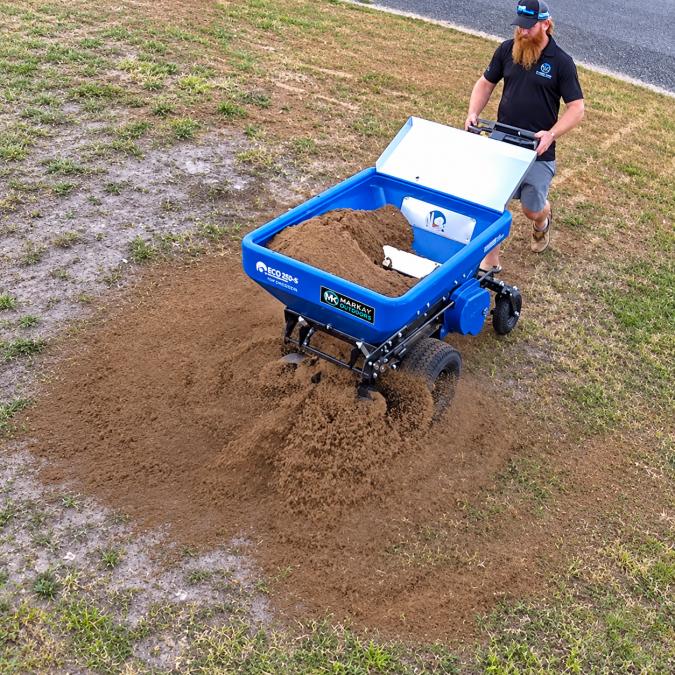
Homeowner operating a self-propelled top dresser across a residential lawn on a sunny day, showing the machine spreading material evenly across the grass in parallel passes
Prepare the lawn first. Mow to a reasonable height and remove sticks, stones, and debris. If you've aerated, the holes are now ready to receive material. If the lawn is very hard and dry, water it lightly the day before, moist soil accepts material better than bone-dry ground.
Choose the right material. Not all top-dressing materials are equal. Sand works for levelling. Compost adds organic matter. Blended mixes do both. The Top Dresser Hire Mackay from MarKay Outdoors is purpose-built for fine materials like sand and screened compost. It won't handle oversized or wet material, so check your material is appropriate before you start.
Set the spreading width. The spreader adjusts from approximately 1.22 metres to 5.49 metres wide. Wider settings cover ground faster but require more passes to achieve even coverage. Narrower settings give you better control on smaller lawns.
Make overlapping passes. Run the spreader in straight lines across the lawn. Overlap each pass slightly to avoid missing strips. Two or three passes in different directions ensures even coverage.
Keep the hopper full. The spreader holds 326 litres. On larger lawns, you'll refill multiple times. Keep material consistent so the depth stays even.
Aim for the right depth. Most lawns benefit from 3-6 millimetres per pass. This is enough to fill aeration holes and level minor variations without smothering the grass. The spreader can apply up to 6.35 millimetres per pass, so one careful pass is often enough.
Water after spreading. Once you've finished, water the lawn gently. This helps material settle and keeps grass from drying out.
ECO250-S Sand Spreader & Top Dresser →
DIY Lawn Levelling Techniques With Top Dressing
Levelling an uneven lawn is one of the most common uses for top dressing.
Minor bumps and dips are best tackled gradually. Spreading too much material at once smothers grass and creates a thick, uneven layer. Instead, make multiple light passes over several weeks.
Identify low spots first. Walk the lawn and mark areas that are noticeably lower. These are your priority. High spots can be addressed separately, sometimes by removing soil, sometimes by accepting them if they're minor.
Target problem areas. You don't have to dress the entire lawn if only parts need levelling. Concentrate material on low spots.
Work in stages. One pass of 3-4 millimetres is better than one heavy pass of 10 millimetres. Grass recovers better, and you have more control. Repeat over two or three weeks if needed.
Watch for settling. Material settles as grass grows through it and as the lawn is used. This is normal. Plan for slight settling when you're aiming for a final level.
Combine with aeration. If low spots are caused by compaction, aerate first. This relieves pressure and allows top dressing to work into the soil rather than just sitting on the surface.
Choosing the Right Top-Dressing Materials
The material you choose determines your results.
Sand is ideal for levelling. It compacts well, doesn't wash away easily, and fills aeration holes effectively. Pure sand works best on lawns that don't need organic matter. The top dresser hire equipment is specifically designed for sand and fine materials.
Compost adds organic matter and improves soil structure. It's heavier than sand and breaks down over time, feeding the soil. Use screened compost to avoid lumps and debris.
Blended mixes combine sand, compost, and loam. These are versatile and work for most lawns. They level, improve soil, and encourage growth all at once.
Pulverised soil is finer than standard topsoil and works through a spreader more easily. It's good for improving structure without the weight of full compost.
Lime and pelletised products can be spread using a top dresser if they're appropriately screened. These are specialty applications, check with your supplier before hiring equipment.
The key is choosing material that's screened and suitable for your spreader. Wet, oversized, or unsuitable material won't feed through the machine correctly.
Material Type |
Best For |
Application Depth |
|---|---|---|
Sand |
Levelling, drainage |
3-6 mm |
Compost |
Soil improvement, organic matter |
3-6 mm |
Blended mix |
General renovation |
3-6 mm |
Pulverised soil |
Structure improvement |
3-6 mm |
Getting Started With Equipment Hire
Doing a lawn renovation yourself saves money and gives you control over the process.
Assess your lawn. Walk it and identify what needs fixing. Are there bare patches, compaction, thatch buildup, or uneven areas? This determines which equipment you need.
Plan your sequence. If your lawn is heavily thatched or compacted, start with dethaching and aeration. If it's mainly uneven, top dressing alone may be enough. Most complete renovations benefit from all three steps.
Hire the right equipment. Top Dresser Hire Mackay, Dethatcher Hire Mackay, and Aerator Hire Mackay are all available from MarKay Outdoors.

Dethatcher Hire Mackay | Lawn Scarifier & Thatch Removal
Frequently Asked Questions
What are the main benefits of top dressing a lawn?
Top dressing improves soil structure, levels uneven surfaces, enhances water and nutrient retention, and prepares your lawn for renovation. It fills minor low spots, smooths bumpy areas and creates a better growing environment for grass roots. When combined with aeration, top dressing helps compacted soil recover and allows air, water and nutrients to penetrate deeper into the soil profile.
How does lawn aeration and top dressing work together?
Aeration removes small soil plugs to relieve compaction and create pathways for air and water. Top dressing then fills those aeration holes and adds nutrient-rich material across the lawn surface. The combination is more effective than either treatment alone because the aeration opens the soil, allowing top-dressing material to work deeper into the lawn profile and improve overall soil health and grass growth.
When is the best time to top dress a lawn?
Top dress during the growing season when grass can recover and establish itself in the new material. Autumn and spring are ideal in most climates. Avoid top dressing during extreme heat or drought, as the lawn needs moisture to help settle the material and support new growth. Ensure adequate watering before and after top dressing to help the grass establish.
Can I use a top dresser on a small residential block?
Yes. The ECO250-S top dresser available for hire is only 864 mm wide, making it suitable for residential properties whilst still covering substantial ground quickly. It adjusts to spread material across widths from approximately 1.22 m to 5.49 m, so you can control coverage and work efficiently across backyards of various sizes without damaging garden beds or fences.
Top dressing transforms tired lawns into healthy, level turf. When combined with aeration and dethaching, it's one of the most effective DIY renovation strategies available. MarKay Outdoors provides all the equipment you need to complete a full lawn renovation yourself. View equipment and hire prices to book your top dresser, aerator, and dethatcher today.